There was a time when markets moved at the speed of a fax machine. Investors woke up, read the morning paper, checked the Dow at the close, and maybe caught an analyst interview on cable news.
Those days are long gone.
Today, markets move at the speed of a tweet.
In the current environment—shaped by the war involving Iran, rising geopolitical tensions, and an economy still navigating inflation pressures—information has become one of the most valuable assets an investor can have. Increasingly, that information flows first through social media platforms like X, Reddit, YouTube, and even TikTok before it reaches traditional financial media.
For modern investors, social media has become part newsroom, part trading floor, and part sentiment meter.
But here’s the insider secret: experienced investors rarely use social media the way casual traders do.
They use it to read the room.
Markets are driven as much by psychology as by economics. The fastest way to understand that psychology today is to watch how narratives spread online. When a rumor about oil tanker disruptions circulates, when defense spending trends in Washington, or when inflation fears suddenly dominate investor conversations, markets often react within minutes.
In that sense, social media functions as a living sentiment indicator—a modern version of the trading floor chatter that once echoed through Wall Street offices.
During geopolitical crises, this becomes even more important.
Energy markets are often the first to react. A single report about shipping disruptions in the Persian Gulf can push oil futures higher almost instantly. Traders who monitor social media discussions among energy analysts, shipping trackers, and geopolitical commentators often see those signals long before the broader market catches on.
But beyond social media chatter, seasoned investors also watch a handful of lesser-known tools that can reveal where money is actually moving.
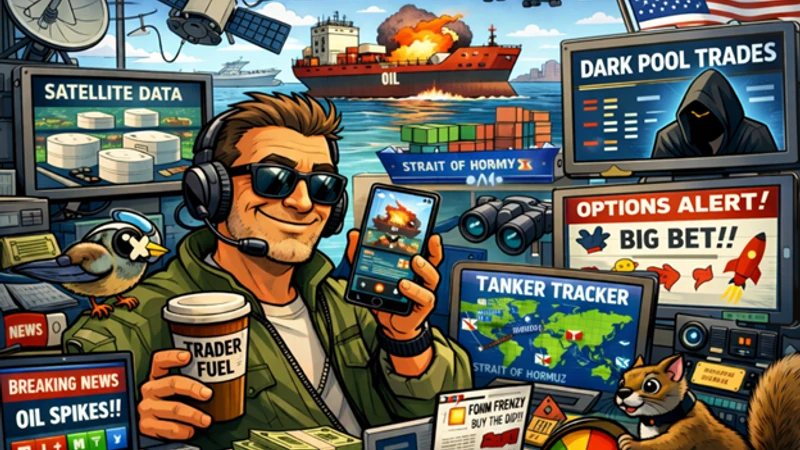
One of the most fascinating is dark pool trading activity. Dark pools are private exchanges where large institutional investors quietly execute massive trades without immediately revealing them to the public market. When dark pool activity spikes in certain sectors—such as energy or defense—it can indicate that institutional money is positioning ahead of broader market moves.
Another powerful tool is unusual options flow. Professional traders closely monitor options markets to see where large investors are placing aggressive bets. When large blocks of call options suddenly appear in sectors tied to geopolitical developments—such as oil, shipping, or aerospace—it can signal that sophisticated investors expect movement before the news becomes widely known.
Then there are the tools that sound more like something out of a spy movie.
Some investors now monitor satellite data that tracks oil storage levels around the world. These satellites can measure the shadow levels inside crude oil tanks, allowing analysts to estimate how much oil is actually being stored globally. When inventories begin to drop unexpectedly, it can signal tightening supply well before official reports are released.
Similarly, global tanker tracking systems allow investors to follow oil shipments in real time. Because much of the world’s energy supply passes through strategic chokepoints—such as the Strait of Hormuz—tracking tanker movement can reveal potential supply disruptions days before markets fully react.
Even air traffic and cargo data have become market indicators. When military aircraft activity increases in certain regions or shipping patterns suddenly change, analysts sometimes detect the economic implications before official policy announcements are made.
Meanwhile, social media remains the accelerant that spreads these signals across markets.
One technique experienced traders watch is what could be called “narrative velocity.” When a market story jumps from a handful of analysts to widespread social media discussion within hours, it often signals that investors are preparing to move capital quickly.
Another subtle indicator is sector chatter tracking. When conversations about industries like energy, defense, shipping, or commodities suddenly spike across investor communities, it can indicate that market attention—and eventually investment flows—may be shifting in that direction.
Of course, not all signals are digital.
“In modern markets, the smartest investors aren’t just watching stocks—they’re watching satellites, shipping routes, and the speed of a story spreading online.”
Seasoned investors also watch the classic relationships that have guided markets for decades. When oil prices spike while the VIX—the market’s so-called fear gauge—begins to rise, it often signals that investors are preparing for broader economic disruption. When the U.S. dollar strengthens at the same time, it usually indicates global investors are seeking safety.
Put all these signals together, and a picture begins to form.
Markets are no longer reacting to yesterday’s news. They are reacting to real-time data streams—satellites in orbit, ships crossing oceans, algorithms scanning social media, and institutional money quietly repositioning behind the scenes.
Yet despite all this technology, one truth remains unchanged.
Noise is not the same as signal.
Social media is filled with opinions, speculation, and emotional reactions. Successful investors treat it like radar—not something that tells them exactly where to go, but something that helps detect storms forming on the horizon.
Because in the end, the fundamentals of investing still matter most.
Corporate earnings matter. Economic growth matters. Strong companies still win over time.
What has changed is simply the speed at which markets process information.
For investors who learn how to read these modern signals—social sentiment, institutional positioning, and global data streams—the chaos of today’s markets can become something else entirely:
An opportunity.