The artificial intelligence narrative has officially transitioned from a speculative frontier into a heavy capital-expenditure reality. For early-stage and institutional investors alike, treating AI as a monolith is a fast track to capital destruction. To find true value—and protect against impending margin compression—one must look at the technology through a strict, multi-layered stack architecture.
A rigorous, top-to-bottom audit of the artificial intelligence landscape reveals exactly where cash is being burned, where defensive moats exist, and where the next phase of enterprise value will be unlocked.
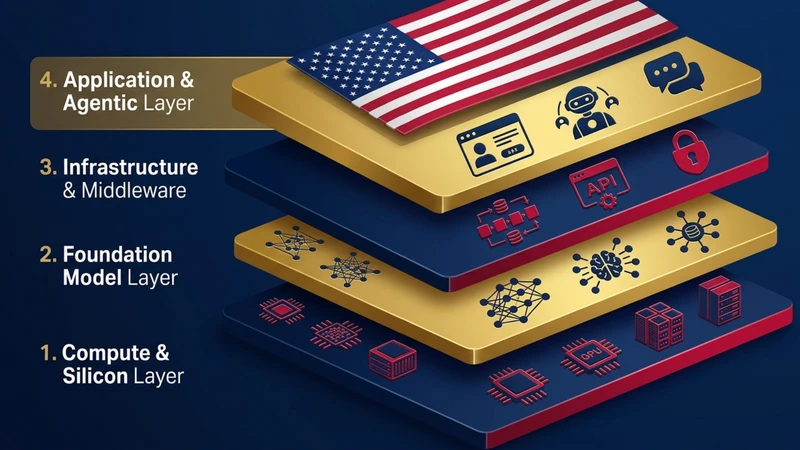
1. The Silicon and Compute Layer (The Foundation)
At the absolute bottom of the stack sits the physical infrastructure: compute, data centers, and advanced semiconductors.
- The Reality: This remains the most capital-intensive segment of the entire ecosystem. The market is currently defined by massive infrastructure outlays, where hyperscalers are spending tens of billions of dollars annually to secure next-generation GPU clusters.
- The Moat: High. The hardware layer features substantial barriers to entry due to extreme supply chain complexity, specialized manufacturing dependencies, and massive technical debt required to build competing silicon architecture.
- The Cautionary Note: We are witnessing an infrastructure buildout that assumes infinite demand elasticity. While hardware providers are capturing massive upfront revenues, the downstream software layers must eventually generate enough cash flow to justify this structural footprint. Investors must watch for signs of overcapacity or a cyclical correction in capital expenditures.
2. The Foundation Model Layer (The Core Engines)
Directly above the hardware sits the large language models (LLMs) and multi-modal models that serve as the cognitive engines of the industry.
- The Reality: This layer is a battleground of compounding technical capabilities and diminishing economic moats. The performance delta between proprietary, venture-backed frontier models and open-source alternatives is shrinking at an accelerating rate.
- The Moat: Low to Medium. Training a frontier model from scratch costs hundreds of millions of dollars, yet raw performance is rapidly becoming commoditized. A model that leads the benchmarks today can find its competitive edge erased by an open-source alternative tomorrow.
- The Cautionary Note: Raw intelligence is becoming too cheap to meter. Betting exclusively on companies whose primary asset is a base model is a high-risk proposition. Without unique data flywheels or highly locked-in distribution channels, foundation model companies risk facing zero-margin pricing wars.
3. The Infrastructure and Middleware Layer (The Plumbing)
This is the connective tissue of the stack—the software tools that allow developers to deploy, fine-tune, secure, and manage AI models efficiently. This includes vector databases, data pipeline tools, security guardrails, and orchestration frameworks.
- The Reality: As enterprises move from experimental pilots to production-grade deployments, the focus is shifting heavily toward data readiness and operational stability. Algorithmic pitch screening tools and diagnostic frameworks are increasingly relying on this layer to analyze unstructured enterprise data safely.
- The Moat: Medium to High. Companies that successfully imbed themselves into an enterprise's data workflow or security architecture create high switching costs. When a company relies on a specific infrastructure tool to maintain its proprietary data pipeline, removing that tool introduces massive operational friction.
- The Cautionary Note: The middleware layer is highly fragmented. Many point-solutions are highly vulnerable to being absorbed as native features by larger cloud platforms or foundation model providers. Investors must separate temporary feature-sets from enduring platform infrastructure.
4. The Application and Agentic Layer (The Interface)
At the top of the stack are the consumer and enterprise applications—the software that solves a highly specific end-user problem. The industry is currently moving away from simple "wrapper" applications and shifting toward autonomous agents capable of executing multi-step workflows.
- The Reality: This is where the ultimate commercial battle will be won or lost. The value here is not driven by the underlying model, but by deep workflow integration and domain-specific utility.
- The Moat: Variable. Success at the application layer requires moving past the rehearsed boardroom script of generic automation. The true winners are those targeting highly specific functional superpowers within niche industries, pairing standard models with deeply proprietary institutional workflows.
- The Cautionary Note: If an application's core functionality can be replicated with a clever prompt on a general-purpose model, it does not possess a defensive moat. Investors must look for applications that own the end-to-end user workflow, possess deeply entrenched data loops, and demonstrate a clear path to unit-economic viability from day one.
The Playbook Moving Forward
The artificial intelligence sector is undergoing an essential sorting mechanism. The period of blind capital allocation based on speculative promise is concluding.
A disciplined investment thesis requires structural skepticism toward top-of-stack hype, paired with an aggressive appreciation for foundational business fundamentals. Look for deep workflow integration, evaluate true switching costs, and ensure that any target asset possesses a clear, defensible mechanism for capturing value rather than just renting compute.