In the world of investing, money is never free. Whether it is sourced from a founder’s savings, a venture capitalist’s fund, or a public bond offering, capital carries a price tag. This "cost of money"—known professionally as the cost of capital—is the invisible hand that determines which companies scale to the moon and which ones never leave the launchpad.
Understanding how this cost evolves is essential for any investor looking to navigate the transition from high-octane startups to steady-state blue chips.
The Early-Stage Premium: Pricing the Unknown
For an early-stage company, the cost of money is at its absolute zenith. At this phase, the "price" is rarely expressed as an interest rate; it is expressed in equity.
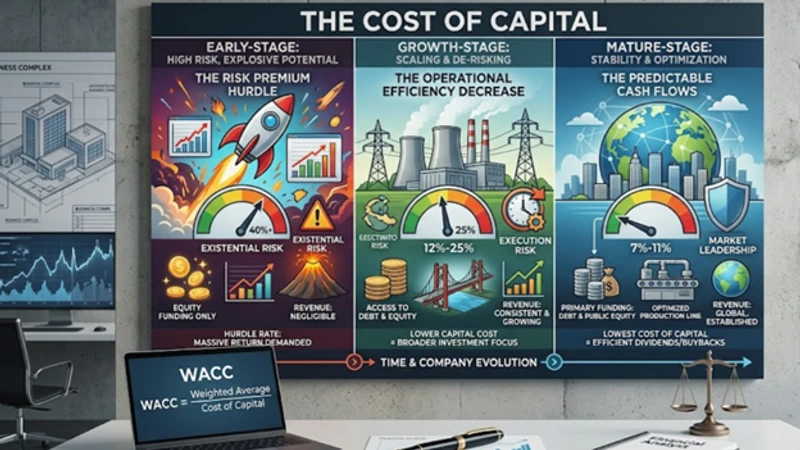
Early-stage investors are not just lending funds; they are pricing the extreme risk of total loss. Because the failure rate of startups is high, the cost of capital must be high enough to compensate for the "zeros" in a portfolio. A Seed or Series A investor typically looks for a 30% to 50% internal rate of return (IRR).
When capital is this expensive, a company’s "hurdle rate"—the minimum return it must generate on its activities—is massive. This forces early-stage founders to focus exclusively on hyper-growth. If a project only promises a 10% return, it is effectively a "value-destroying" activity for a startup, even if it looks profitable on paper.
The Growth Phase: De-Risking the Model
As a company finds product-market fit and begins to generate consistent revenue, the cost of money begins to descend. The "existential risk" starts to fade, replaced by "execution risk."
At this stage, the company gains access to a broader menu of capital, including venture debt and mezzanine financing. Because the probability of survival is higher, investors are willing to accept a slightly lower risk premium—often in the 20% to 30% range. This drop in the cost of capital allows the company to invest in longer-term infrastructure and market-share expansion that might have been too "expensive" to fund during the seed stage.
The Mature Phase: The Efficiency Machine
By the time a company reaches maturity, it has predictable cash flows and tangible assets. It no longer needs to promise 50% annual returns to attract a dollar of investment.
For these firms, the cost of capital is at its lowest, often hovering between 7% and 12%. They can borrow money cheaply from banks or issue corporate bonds. This low cost of money changes the strategy: the company can now justify low-margin projects, such as incremental supply chain efficiencies or modest product line extensions.
"The cost of capital is the ultimate filter; it decides not just what a company does, but what it is allowed to become."
The Bottom Line
For the investor, the lesson is clear: the cost of money is not static. It is a reflection of risk, time, and market conditions. When interest rates rise globally, the "floor" for the cost of money rises for everyone, often hitting early-stage valuations the hardest. In a world where money has a price, the winners are those who can generate a return on invested capital (ROIC) that consistently stays above their cost of money.