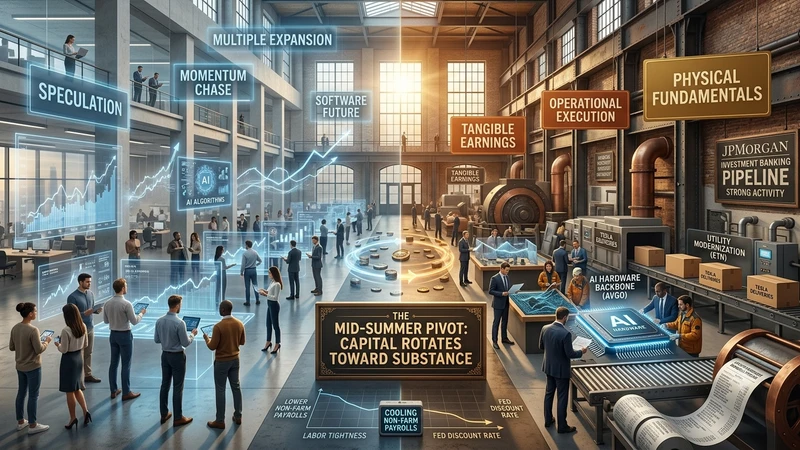
As we navigate the first full trading week of July 2026, a distinct structural shift is occurring beneath the surface of the major indices. The momentum-driven, AI-heavy environment that dominated the first half of the year is giving way to a traditional mid-summer tug-of-war—one that heavily favors execution, tangible earnings, and physical fundamentals.
For investors analyzing their macro strategy for the coming weeks, the narrative is no longer about chasing exponential valuation multiples. Instead, capital is rotating toward businesses with visible catalysts, defensive structural moats, and the physical capacity required to support the next leg of economic expansion.
The Fed Calculus Realignment
The primary catalyst for this shift was last Thursday’s June non-farm payrolls report. Coming in significantly cooler than anticipated at just 57,000 jobs added versus the consensus estimate of 115,000, the data signaled an unmistakable moderation in the labor market.
While a slowing job market traditionally flashes cautionary signals, Wall Street interpreted the print through a monetary policy lens. The weak data has effectively removed the tail-risk of any further interest rate hikes by the Federal Reserve this autumn. Investors are parsing this macro development closely, looking ahead to the release of the June FOMC meeting minutes for definitive clues on the runway toward an eventual rate pivot or pause. This newly found breathing room has directly benefited rate-sensitive mid-caps, value sectors, and capital-intensive structural plays.
Macro Framework: Lower labor tightness reduces systemic inflation pressure (ΔP < 0), stabilizing the discount rate applied to long-duration corporate cash flows and allowing capital to look beyond defensive tech mega-caps.
The Rotation Matrix: Physical Infrastructure & Delivery
Rather than exiting the equity market, institutional capital is executing a precise rotation out of pureplay software multiples and into tangible asset leaders. We see this unfolding across three primary market vectors:
1. Real-World Execution over Projections
The market is beginning to reward immediate operational results over distant promises. A prime example is Tesla (TSLA), which captured heavy positive momentum after defying consensus expectations by delivering over 480,000 vehicles in Q2, substantially beating the 410,000 Wall Street estimate. By aggressively clearing global backlogs and optimizing localized inventories, the company proved that operational execution still dictates price discovery, setting up a highly anticipated July 22nd earnings report.
2. The Hardware Backbone of AI
Investors have come to a critical realization: artificial intelligence cannot scale without massive physical infrastructure. Software architectures require a robust physical foundation. Consequently, hardware and networking giants like Broadcom (AVGO) are experiencing strong institutional inflows.
Broadcom's dominance in custom application-specific integrated circuits (ASICs) and high-speed data center networking serves as the literal plumbing of the modern cloud. With the company projecting an exceptional $16 billion in AI-associated semiconductor revenue for fiscal Q3—a triple-digit yearover- year surge—and locked-in compute agreements stretching through 2027, the street is heavily prioritizing hardware certainty over software speculation.
3. Industrial Resilience and Energy Stabilization
This infrastructure buildout is driving unprecedented demand through the industrial and utility complexes. Companies focused on grid modernization and data center power management, such as Eaton (ETN), are logging record-high order backlogs.
This industrial expansion is further supported by a constructive macro shift in the energy sector. Recent diplomatic breakthroughs regarding U.S.-Iran negotiations have lowered risk premiums surrounding the Strait of Hormuz. As crude oil prices trend steadily downward, it provides a meaningful margin cushion for industrial manufacturing and traditional transport sectors.
4. Financial Capitalizing on Re-Opening Pipelines
As the broader economy stabilizes under a predictable Fed framework, big banking is positioned to capture an uptick in corporate activity. JPMorgan Chase (JPM) stands out as a core beneficiary. With the investment banking deal pipeline opening up and net interest margins holding steady, the financial bellwether is drawing strong buy-side interest ahead of its Q2 earnings report next week.