If you spend enough time watching markets during bouts of geopolitical tension, a pattern emerges: investors fixate on the most dramatic bottleneck while quietly ignoring everything else that’s still functioning.
Right now, that bottleneck is the Strait of Hormuz.
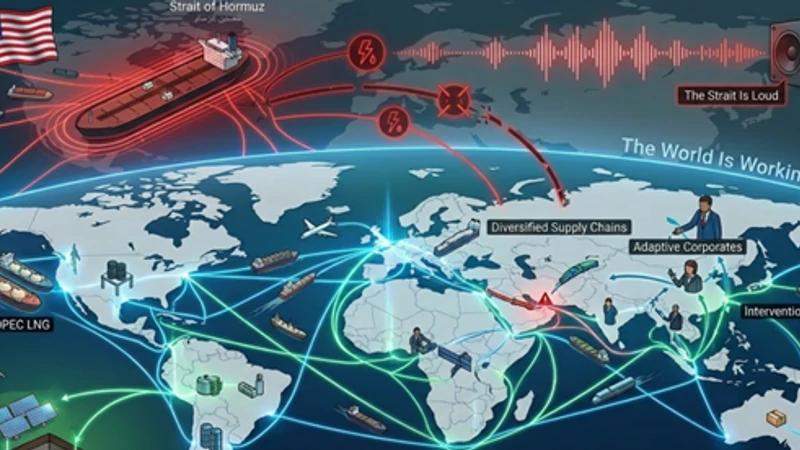
It’s easy to see why. It is systemically vital, deeply sensitive, and capable of sending oil prices vertical with a single headline. But there is a growing risk that we are anchoring too hard on this one chokepoint and missing the broader forest for a very specific tree. While the news coming out of the Strait is loud, the rest of the global economy is—almost uncomfortably—resilient.
The System Is Bigger Than the Bottleneck
Markets crave clean narratives, usually some variation of disruption leads to scarcity, which leads to a slowdown. Reality, however, is much messier and far more adaptive.
Even as the world fixates on Gulf risks, the global system is doing what it has learned to do best over the last five years: it’s rerouting in real time. Our supply chains are more diversified than they were pre-pandemic. Energy systems are more flexible, bolstered by a surge in LNG routing, non-OPEC supply, and significantly deeper storage buffers.
In short, the world took notes during the pandemic, the invasion of Ukraine, and the subsequent inflation shock. It hasn't forgotten those lessons. Governments are quicker to intervene, and corporates are faster at repricing and reallocating. We are currently pricing the vulnerability of a single corridor while underestimating the muscle memory of an entire global network.
What the Crowded Trade Misses
This fixation on Hormuz creates a subtle distortion in positioning. It overweights the "tail risk"—the worst-case scenario—and underweights baseline resilience. This leads to a market stance that assumes energy shocks will be linear and growth will simply roll over.
But look at the data. The shock isn't being ignored; it’s being absorbed. Freight reroutes, inventories act as a shock absorber, and alternative suppliers step into the gap. This doesn’t eliminate risk, but it fundamentally changes its shape.
If the world continues to perform this "admirably," the most interesting trades over the next quarter aren't the obvious hedges. They are the plays that bet on the system bending without breaking:
- Selective Industrials: Look for companies tied to infrastructure and logistics optimization. They aren't just riding a boom; they are fulfilling the "adaptation demand" as the world reconfigures.
- Non-U.S. Growth: Specifically in Asia (excluding major energy-stress points). If the worst-case energy disruption fails to materialize, these markets—which have already discounted the chaos—could see a sharp re-rating.
- The Tech Floor: Energy shocks don't fundamentally impair AI infrastructure or software scaling. As long as rates don't spike uncontrollably, this sector remains structurally supported.
- Diversified Commodities: Crude gets the headlines, but metals tied to electrification and supply chain realignment may offer more durable support as the "oil panic" volatility eventually fades.
The Rotation No One Is Talking About
There is a more subtle implication here. If the consensus is over-positioned for total disruption, the real market move may actually come from "disappointment" in the disruption trade.
We’re already seeing glimpses of this: oil struggling to hold extreme levels, defense stocks stalling after a massive run, and broader equities stabilizing despite the headlines. This isn’t a "risk-on" melt-up; it’s a slow, quiet recognition that things are… fine enough. And in this environment, "fine enough" is often all the fuel a market needs to move higher.