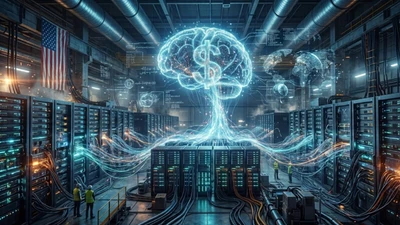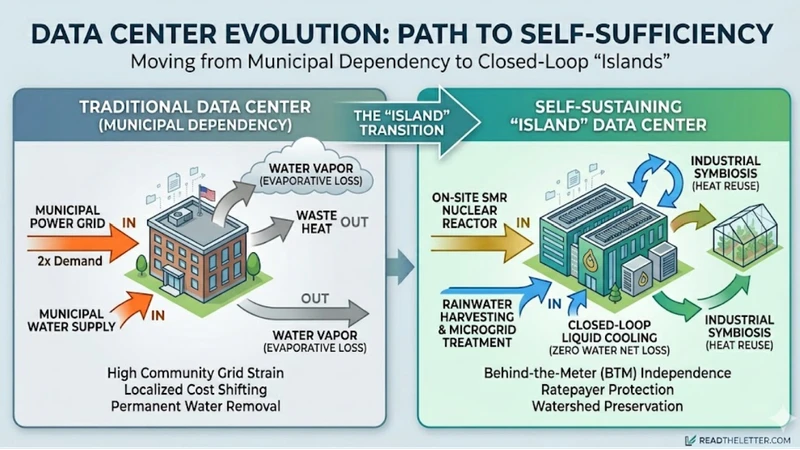
When we talk about the artificial intelligence boom, the conversation usually focuses on algorithmic breakthroughs, skyrocketing valuations, and GPU unit shipments. What we rarely look at is the physical, industrial footprint required to keep those models running. AI doesn't live in a nebulous cloud; it lives in massive, monolithic concrete structures packed with silicon that pull an unprecedented amount of resources from local communities.
To understand the scale of this pressure, one only needs to look at Northern Virginia—the undisputed data center capital of the world. Affectionately known as "Data Center Alley," Loudoun and Fairfax counties handle an estimated 70% of the world’s internet traffic. But as standard cloud storage makes way for generative AI clusters, the local utility infrastructure is hitting an inflection point. With data centers facing pushback over strained municipal grids and depleted watersheds, the industry is arriving at a radical conclusion: the only way to keep growing is to stop relying on cities entirely. The future of the data center is a completely self-sustaining, closed-loop "island."
Bypassing the Grid with "Bring Your Own Power"
Historically, U.S. electricity demand remained nearly flat for almost two decades. Utilities could easily plan around a stable, predictable baseline. AI completely broke that model. Training a single large language model can consume more power than hundreds of American homes use in an entire year. In Northern Virginia, this has forced massive grid expansions, accelerated the building of extra-high-voltage transmission lines, and threatened to raise rates for everyday consumers.
To sidestep this friction and bypass years-long utility interconnection queues, hyperscalers are turning to a movement known as BYOP (Bring Your Own Power). Instead of tapping into the local municipal grid, next-generation data centers are deploying behind-the-meter (BTM) microgrids.
The gold standard for this self-sustaining shift is co-located nuclear energy. Tech giants are signing massive agreements to position computing clusters directly adjacent to existing nuclear plants, or actively funding the development of on-site Small Modular Reactors (SMRs). Because nuclear energy operates at full capacity around the clock, it aligns perfectly with the 99.999% uptime reliability AI requires. By generating their own baseline power on-site, these facilities protect local municipal ratepayers from subsidizing massive infrastructure upgrades.
Decoupling from the Local Watershed
While power grids get the headlines, water is the quiet crisis. Supercomputers generate staggering amounts of heat. To prevent hardware failure, traditional data centers rely heavily on evaporative cooling systems. In 2023, Northern Virginia data centers consumed close to 2 billion gallons of water—a 63% increase in just four years, permanently evaporating precious volume out of the Potomac River Basin.
To operate as true island entities, modern data centers are changing how they manage thermodynamics:
- Zero-Consumption Closed-Loop Cooling: Rather than using water once and evaporating it into the sky, self-sustaining facilities use closed-loop liquid cooling. Much like a car's radiator, a fixed volume of treated water or specialized dielectric fluid continuously cycles through the servers, absorbs the heat, routes to an air-cooled heat exchanger, and returns to the system. The net loss to the local water supply is exactly zero.
- Industrial Symbiosis: Rather than treating heat as waste to be dumped into the environment, island data centers are beginning to capture the thermal exhaust. This low-grade heat is diverted to warm adjacent commercial greenhouses, power district heating networks for neighboring buildings, or drive desalination processes.
- Autonomous Water Microgrids: Where water is required for auxiliary systems, island data centers are deploying independent purification and rainwater harvesting frameworks. They treat, cycle, and reuse their own greywater entirely outside standard municipal sewer contracts.
The era of data centers acting as pure resource drains on local municipalities is coming to an end. By transitioning into hyper-engineered, self-contained ecosystems that generate their own clean power and recycle their own water, the tech industry may finally decouple digital expansion from community depletion.