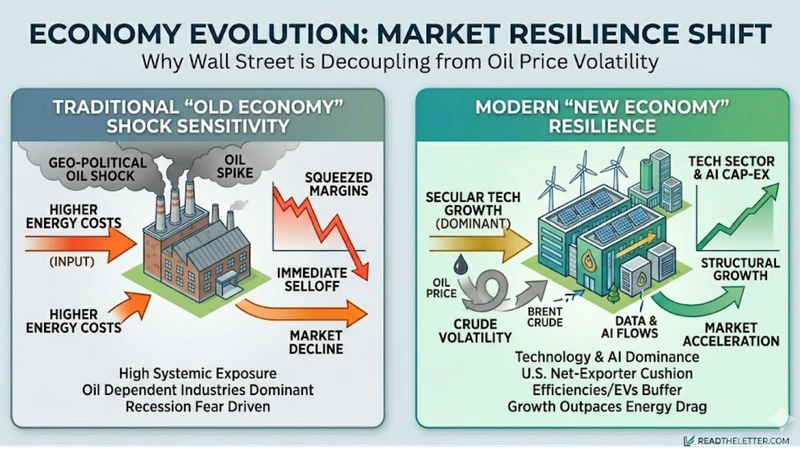
For decades, the global economic script followed a predictable pattern: when geopolitical tensions flared, oil prices spiked, and the stock market took a dive. Higher energy costs acted as an immediate tax on both corporations and consumers, squeezing margins and killing discretionary spending.
Yet, over the past year, we’ve witnessed a massive decoupling. Even with Brent crude bouncing wildly—briefly surging past 100 dollars a barrel due to major disruptions like the temporary closure of the Strait of Hormuz—the broader equity markets have shown staggering resilience.
This isn't a fluke; it's a structural evolution in how the modern economy is built.
1. The Technology-Driven Secular Growth Engine
The primary reason the S&P 500 has shrugged off energy volatility is its composition. The index is no longer dominated by heavy manufacturing, transportation, and traditional industrial giants. Instead, the market's primary engines are mega-cap technology and software companies.
Corporate capital expenditure is currently being funneled into artificial intelligence infrastructure, enterprise software, and cloud computing—not fuel. For an alphabet-soup array of tech titans, the cost of a barrel of crude has zero impact on the adoption rate of their software platforms or their quarterly subscription revenues. The secular growth trend of digital transformation is simply strong enough to outpace the cyclical drag of higher energy costs.
2. The U.S. Net-Exporter Cushion
The macroeconomic reality of the United States has fundamentally shifted over the last fifteen years. The U.S. is now the world’s leading producer of crude oil, thanks to advancements in domestic shale production.
In the 1970s or early 2000s, an oil spike meant a massive transfer of wealth from American consumers straight to foreign producers. Today, when oil prices rise, that capital stays largely within the domestic ecosystem. Higher oil prices act as a direct revenue boost for American energy sectors, driving domestic capital expenditure, employment, and dividend payouts that balance out the pain felt at the consumer pump.
3. Efficiencies in the Real Economy
It takes significantly less oil to generate a dollar of GDP today than it did thirty years ago. From hybrid and electric vehicle fleets to highly optimized supply chains and remote work policies that curb daily commuting, the real economy has insulated itself against energy price shocks.
While a sustained oil shock above 150 dollars a barrel still carries the threat of a broader global recession, the modern stock market has proved that minor, volatile bumps in energy costs are no longer enough to derail an corporate earnings engine powered by silicon, software, and structural independence.