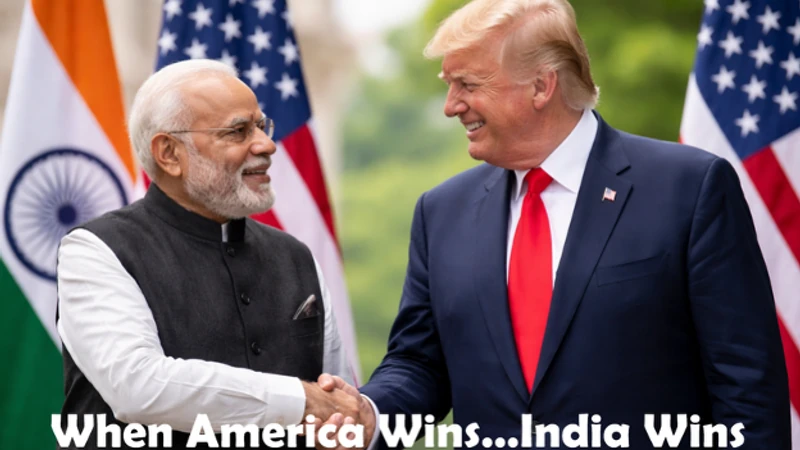
Yesterday, President Trump announced a new trade and tariff deal with India—and Wall Street’s first reaction missed the point.
This deal isn’t about cheaper T-shirts or marginal GDP bumps. It’s about power.
And for Republican investors, that distinction matters.
At its core, the India deal is being widely interpreted as a deliberate move to cut Russia and China out of key supply chains that touch U.S. economic security—from manufacturing to defense, technology, and critical inputs. Tariffs are simply the visible mechanism. The real story is leverage.
Pull Quote:
“This isn’t a trade deal. It’s a strategic realignment—with tariffs doing the heavy lifting.”
Tariffs as a Weapon, Not a Tax
Traditional free-market orthodoxy says tariffs are inefficient. In isolation, that’s true.
But Trump has never treated tariffs as an economic purity test. He treats them as pressure points.
In this case, tariffs are being used to:
- Force reciprocity from India
- Redirect capital flows away from China
- Undermine Russia’s relevance in strategic trade corridors
- Lock India more tightly into a U.S.-aligned economic orbit
From an investor perspective, this is less about short-term pricing friction and more about long-term certainty of alliance.
Markets can price costs. They struggle to price chaos.
Why India, and Why Now
India checks several boxes that China no longer does:
- A massive, growing workforce
- Democratic alignment (messy, but durable)
- Rising manufacturing capability
- Strategic hostility toward China
- Willingness to play the long game with the U.S.
By elevating India as a preferred partner, the U.S. is quietly signaling to multinationals and capital allocators: this is the safer side of the chessboard.
For Republican investors, this aligns with a broader thesis:
- National resilience over global dependency
- Friendly nations over adversarial efficiency
- Security before marginal margin optimization
What This Means for Russia and China
This deal matters precisely because of who it sidelines.
China loses:
- Manufacturing leverage
- Supply chain dominance
- The narrative that it’s “too big to replace”
Russia loses:
- Influence in emerging market trade
- Defense and energy adjacency
- Relevance in Indo-Pacific economic strategy
In other words, capital that might have flowed east or north is being redirected south—through India, and back toward U.S.-aligned systems.
That’s not accidental. And it’s not temporary.
Where Republican Investors Should Be Focused
This deal favors investors who think in decades, not quarters.
Potential beneficiaries include:
- Defense and aerospace firms with India exposure
- Manufacturing platforms diversifying out of China
- Infrastructure and logistics tied to South Asia
- U.S. exporters gaining negotiated access to Indian markets
- Energy, data, and industrial tech providers aligned with U.S. security interests
Risks to watch:
- India’s regulatory complexity
- Domestic political shifts inside India
- Short-term tariff noise hitting margins
- Media overreaction to “trade war” headlines
None of these are deal-killers—but they require discipline.
The Bigger Takeaway
Republican investors shouldn’t view this deal through a free-trade purity lens or a CNBC headline cycle.
This is about who controls the pipes of the global economy.
Trump’s India deal signals a continuation of a worldview where:
- Economic policy is national security
- Trade partners are chosen, not assumed
- Tariffs are tools, not taboos
Like it or not, the era of naïve globalization is over. This deal accepts that reality—and tries to shape it.
For investors who understand power, not just price, that’s the real opportunity.