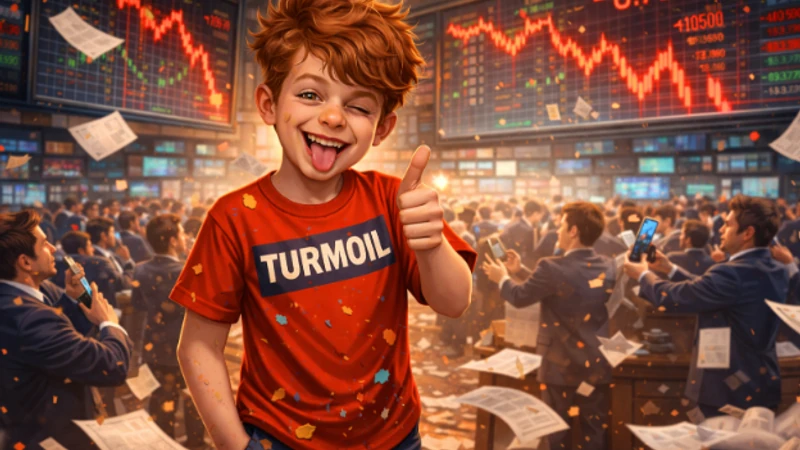
There is always turmoil somewhere.
A war. An election. A policy shock. A rate scare. A media cycle built to convince investors that this moment, unlike every other moment before it, is simply too dangerous to navigate.
It never sounds small while you are living through it. It always feels immediate. Urgent. Different.
But the disciplined investor learns an important truth early: turmoil is not an exception to investing. It is part of investing.
The market has never required comfort in order to create opportunity. In fact, some of the best opportunities appear when confidence is low, emotion is high, and too many people are mistaking noise for insight. That is when calm stops being a personality trait and becomes a competitive advantage.
Investors do not get paid for panic. They get paid for judgment.
And judgment is hardest to maintain when headlines are demanding a reaction. Every day, there is a fresh reason to abandon patience. Sell now. Hide in cash. Wait for certainty. Chase whatever looks insulated from the current storm. Yet that instinct, however understandable, has a way of turning temporary uncertainty into permanent underperformance.
That is because markets do not reward the loudest response. They reward the soundest process.
The investor who stays composed during upheaval is not ignoring risk. He is putting risk in its proper place. He understands that a portfolio is not built for one quarter, one administration, one conflict, or one frightening week in the news cycle. It is built for the full stretch of the road. And any serious long-term strategy must be capable of surviving periods that feel unstable.
That is where professionalism matters.
Professional investors do not confuse activity with action. They do not treat every market swing as a summons to rewrite the entire playbook. They step back. They assess. They distinguish between a change in sentiment and a real change in value. They ask whether the underlying thesis still holds, whether the business is still durable, whether the balance sheet is still strong, whether the cash flows are still credible, and whether the price now offers more value than it did before fear took over.
These are sober questions. They are rarely fashionable. But they are usually profitable.
The investor who cannot stay calm in a storm will eventually hand his wealth to the one who can.
This is why diversification matters. This is why quality matters. This is why liquidity matters. And this is why temperament may be the most underappreciated asset in all of investing.
A great many people want the rewards of long-term investing, but fewer are willing to endure the discomfort that long-term investing requires. They want the upside without the volatility, conviction without drawdowns, and gains without periods of doubt. But that is not how markets work. Volatility is not a design flaw. It is the price of admission.
The better response, especially in times like these, is not to become numb. It is to become clear.
Clear about time horizon. Clear about risk tolerance. Clear about what you own and why you own it. Clear about the difference between a temporary repricing and a permanent impairment. Clear about the fact that cable-news urgency is not an investment framework.
There is also a deeper discipline required: the discipline to avoid being psychologically managed by the information cycle. We live in an era that monetizes anxiety. Every alert is framed as a turning point. Every dip is treated like a verdict. Every geopolitical tremor is sold as a reason to rethink everything.
That is not market intelligence. That is emotional outsourcing.
The successful investor does something less dramatic and more effective. He filters aggressively. He respects facts. He keeps perspective. He rebalances where needed, trims excess where appropriate, and adds where value becomes compelling. He remains alert, but not agitated.
In other words, he acts like an owner, not a spectator.
Because ownership is the point. If you own strong assets, productive businesses, real cash flows, and durable enterprises, turmoil should not automatically force surrender. It should force better questions. It should sharpen standards. It should expose weak assumptions. And, if approached correctly, it should create openings for those still capable of thinking clearly while others are losing their nerve.
That is the edge.
With all the turmoil in the world, investors do not need more drama. They need more discipline. They need less theater and more process. Less prediction and more preparation. Less obsession with the next headline and more confidence in a sound framework.
Calm is not passive. Calm is strategic.
And in markets, the investors who keep their heads are often the ones who keep their gains.