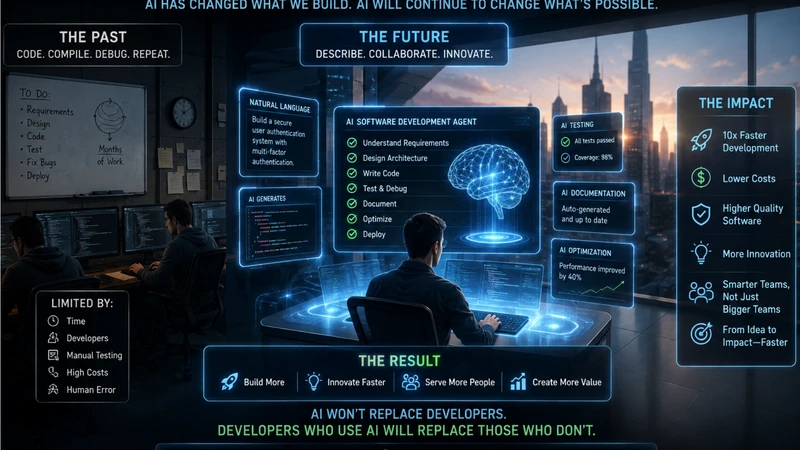
For decades, software development followed a fairly predictable formula: hire developers, give them requirements, spend months building the product, test it, fix it, deploy it, and then hire more developers to maintain it.
Artificial intelligence has started breaking that formula.
What began as AI-assisted coding has rapidly evolved into AI agents capable of writing, testing, debugging, documenting, and increasingly managing significant portions of the software-development process. Gartner predicts that by 2027, more than 65% of engineering teams using agentic coding will treat traditional integrated development environments as optional.
That isn't simply a technology upgrade.
It is an economic change.
And for investors, that distinction matters.
The Software Business Used to Be About Code
Historically, one of the biggest constraints on software companies was the cost and availability of skilled developers.
If you wanted to build a complicated application, you needed programmers. If you wanted to build it faster, you hired more programmers. If you wanted to maintain it, you needed even more programmers.
AI changes the relationship between software and labor.
A developer can now describe what he wants in ordinary language and have AI produce an initial version of the code. AI can then help test it, find errors, rewrite sections, document the system and suggest improvements.
The developer isn't necessarily disappearing.
The developer is becoming a manager of machines that write software.
That distinction could ultimately prove more important than the original invention of the graphical user interface, the cloud or even mobile computing.
McKinsey estimates that AI could affect software-engineering productivity by 20% to 45% of current spending on the function. Its more recent research found that the highest-performing organizations using AI in software development achieved improvements of 16% to 30% in productivity and time to market, while software quality improved by 31% to 45%.
The important word is potential.
The technology is impressive. Turning that capability into profits is another matter.
The Good News for Businesses
Imagine a company that historically needed 20 developers to maintain and expand its software.
If AI allows that same company to accomplish the work of 20 developers with 12 or 15 people, the economics change dramatically.
The company may be able to:
- Build products faster
- Reduce development costs
- Launch more features
- Fix problems faster
- Experiment with more ideas
- Serve more customers without proportionally increasing headcount
- Improve software quality
- Reduce the time between an idea and a commercial product
And there is another benefit that may be even more important.
AI makes software development accessible to more people.
A business owner who couldn't afford a large engineering team may be able to describe a business problem and have AI help create a working solution.
That means the number of people capable of creating software could expand dramatically.
McKinsey's research has already found that developers using generative AI can complete certain complex tasks more effectively and spend less time on repetitive work.
This could unleash an enormous wave of entrepreneurial software development.
The Bad News for Software Investors
Now comes the uncomfortable part.
If software becomes dramatically easier and cheaper to create, software itself can become less scarce.
And scarcity is what creates economic value.
Consider what happens when thousands of companies suddenly have access to inexpensive AI developers.
The cost of building a basic CRM system falls.
The cost of building an accounting application falls.
The cost of building a scheduling application falls.
The cost of building an ecommerce platform falls.
The cost of creating specialized industry software falls.
That sounds wonderful for customers.
It isn't necessarily wonderful for companies selling software.
If competitors can reproduce features faster and cheaper, pricing power can deteriorate.
Investors therefore need to stop asking simply:
"How much revenue does this software company have?"
They need to start asking:
"What prevents somebody from rebuilding this company with AI?"
That is a much more important question.
The Great Software Moat Test
For years, investors have talked about software "moats."
Those moats included proprietary code, development teams, intellectual property and the sheer cost of building a competing product.
AI may weaken some of those advantages.
If a competitor can recreate 80% of your product in months instead of years, your codebase may no longer be much of a moat.
The strongest software companies will increasingly need different forms of protection.
Think about:
Proprietary data.
AI can write code. It doesn't automatically possess your unique customer data.
Customer relationships.
An enterprise customer may not want to rip out a system that runs its business simply because somebody built a cheaper alternative.
Workflow integration.
The deeper a product is embedded into a company's operations, the harder it is to replace.
Network effects.
A marketplace becomes more valuable because of the people using it. AI doesn't automatically eliminate that advantage.
Brand and trust.
When software controls payroll, banking, healthcare records or mission-critical operations, customers aren't necessarily looking for the cheapest code. They're looking for something that works.
Regulatory and compliance infrastructure.
In many industries, building the software is only part of the challenge. Proving that it is secure, compliant and auditable can be considerably harder.
This is one reason AI doesn't automatically mean the end of established software companies. Reuters recently noted that enterprises still face security, audit and scalability considerations that make replacing major platforms with internally generated software much more complicated than simply producing code.
The Biggest Opportunity May Be Smaller Companies
Here's where I think investors should pay particular attention.
AI may allow a small company to compete against a much larger company without carrying the same overhead.
That changes the economics of entrepreneurship.
A company with 15 exceptional employees and a sophisticated collection of AI agents could potentially accomplish work that previously required dozens or hundreds of employees.
That means the next generation of great companies may not necessarily be enormous employers.
They may be enormously productive companies with surprisingly small teams.
This could also change acquisition economics.
A buyer may look at a $20 million revenue software company with 150 employees very differently from a $20 million revenue software company with 35 employees and similar functionality.
The second company could have dramatically better operating leverage.
And operating leverage is one of the things investors ultimately pay for.
But There Is a Dangerous Trap
There is a big difference between writing more code and creating more value.
AI can generate enormous amounts of code very quickly.
That doesn't mean all of that code should exist.
One recent analysis of AI coding agents found a striking gap between code production and software actually shipped: coding output increased dramatically, while the increase in production software was much smaller.
This is an important warning for investors.
Don't be impressed by a company because its AI system can generate millions of lines of code.
Ask what those lines of code produce.
Revenue?
Customers?
Lower costs?
Higher retention?
Better margins?
A faster product cycle?
Those are the numbers that matter.
AI Could Also Destroy Bad Software Businesses
This may be one of the most interesting consequences.
For years, companies have tolerated mediocre software because replacing it was too expensive.
A company might use an outdated system because migrating 15 years of data and retraining employees would cost millions.
AI changes that calculation.
If rebuilding a system becomes dramatically cheaper, companies may finally decide:
"Why are we paying $500,000 a year for this?"
That creates a potentially enormous opportunity for new entrants.
It also creates enormous risk for incumbent software companies whose primary competitive advantage is that customers find them too expensive to replace.
Investors should identify which companies have genuine customer loyalty and which simply have customer inertia.
Those are not the same thing.
The Human Developer Isn't Going Away
The doom-and-gloom argument says AI will eliminate programmers.
I think that's too simplistic.
When computers arrived, accountants didn't disappear.
When spreadsheets arrived, financial analysts didn't disappear.
When desktop publishing arrived, graphic designers didn't disappear.
Technology generally eliminates certain tasks before it eliminates entire professions.
Software development is likely to follow the same pattern.
The job will change.
Instead of spending most of the day writing lines of code, developers will increasingly spend time defining problems, designing systems, reviewing AI-generated work, managing agents, testing results and making architectural decisions.
In other words, the valuable developer may become less like a typist and more like an architect.
That means investors should watch developer productivity, not simply developer headcount.
What This Means for Software Valuations
This is where things get interesting.
Traditional software valuation often rewards:
- Recurring revenue
- High gross margins
- Strong retention
- Revenue growth
- Low customer acquisition costs
- Scalability
AI doesn't eliminate those metrics.
It changes how investors should interpret them.
A company growing 20% while adding enormous numbers of employees may not be as attractive as a company growing 20% while maintaining a tiny workforce and expanding margins.
Likewise, a software company with 90% gross margins isn't automatically a great investment if AI causes competitors to drive prices down.
The question becomes:
Can the company capture the productivity benefits of AI faster than competitors can use AI to attack its business?
That may become one of the defining investment questions of the next decade.
The AI Winners May Not Be AI Companies
This is perhaps the most important investment lesson.
Investors naturally gravitate toward companies selling AI.
But some of the biggest beneficiaries may be companies that simply use AI exceptionally well.
A manufacturer that uses AI to reduce engineering costs.
A bank that automates back-office operations.
An ecommerce company that dramatically improves personalization and customer service.
A logistics company that optimizes routing.
A healthcare company that reduces administrative costs.
A small software company that doubles its development output without doubling its payroll.
The economic winners could be everywhere.
McKinsey estimates that generative AI could ultimately create trillions of dollars of annual economic value across industries, with software engineering, customer operations, marketing and sales, and R&D among the largest opportunity areas.
The investment opportunity therefore isn't simply "buy AI."
It is to identify businesses that convert AI capability into measurable economic results.
The New Investor Checklist
When looking at a software or technology investment, I would add a few questions to the traditional investment checklist.
1. How much of the company's development work can AI automate?
If the answer is "a lot," that's potentially good for the company—but potentially bad for its competitive moat.
2. Does the company own something AI can't easily reproduce?
Data, customers, distribution, network effects, intellectual property, regulatory approvals or specialized domain knowledge can matter enormously.
3. Is AI expanding margins or simply increasing spending?
There's a huge difference.
4. Is the company becoming more productive per employee?
Watch revenue and profit per employee.
5. Can a competitor recreate the product quickly?
If yes, the valuation deserves scrutiny.
6. Is the company selling AI or actually benefiting from AI?
Those are two very different investment theses.
7. What happens if the price of software falls dramatically?
Some businesses will thrive.
Others may discover that their entire valuation was built around scarcity that no longer exists.
The Bigger Picture
The first phase of the internet made information dramatically cheaper.
The cloud made computing dramatically more accessible.
Mobile made software ubiquitous.
AI is now attacking something different:
The cost of creating intelligence and software itself.
That could be much bigger.
If software development becomes 5, 10 or even 20 times more productive over time, the world could see an explosion of software products.
But abundance creates winners and losers.
The winners will likely be the businesses that combine AI with something difficult to replicate: proprietary data, customers, distribution, intellectual property, trusted brands, specialized knowledge or powerful networks.
The losers may be companies whose primary advantage was simply that software was expensive and difficult to build.
For investors, that means the next decade may require a different way of thinking about technology.
Don't simply ask who is using AI.
Ask who becomes economically stronger because of it.
That's where the real investment opportunity is likely to be.