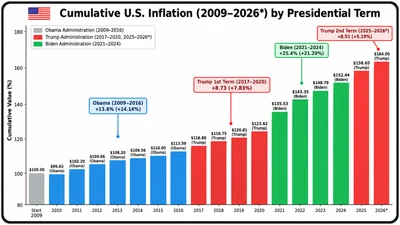
This week brought another flood of headline Key Performance Indicators (KPIs) from Washington federal agencies. While cabinet officials and network commentators rush to put a polished spin on the baseline numbers, a closer look at the actual data shows a very different economic reality for American businesses, working families, and investors.
Behind the headlines lies a clear trend: federal spending, regulatory expansion, and energy policies continue to push wholesale costs higher, putting pressure on bottom-line profit margins and household budgets alike.
Key Takeaways from the Latest Data
Wholesale Inflation Is Re-Accelerating: The October 15 Producer Price Index (PPI) report showed a sharply higher 1.3% month-over-month increase, driving annual wholesale inflation to 6.3%. Energy and supply chain inputs drove the uptick, confirming that price pressures remain active at the supply level before reaching store shelves.
Nominal Retail Gains Masks Purchasing Power Fatigue: Headline Retail Sales posted a 0.8% month-over-month increase. However, because overall prices remain structurally higher than previous baselines, higher checkout totals reflect increased costs for essential goods rather than expanding consumer volume.
Fed Rate Hold Drives Corporate Capital Costs: With wholesale inflation stubbornly persistent, the Federal Reserve remains locked in a elevated rate stance. For middle-market businesses and regional enterprises, high prime rates continue to raise debt service costs and restrict growth capital.
The Economic Overview: Headline Claims vs. Real-World Facts
| Metric / Indicator | Beltway Narrative | On-the-Ground Reality |
| Producer Price Index (PPI) | "Temporary energy cost fluctuations." | Structural Wholesale Pressure: Industrial inputs, diesel, and raw materials are up, creating direct margin pressure for domestic manufacturers and builders. |
| Retail Sales (+0.8%) | "Strong consumer resilience." | Dollar Devaluation at Work: Families are paying more for the same basket of goods, driven by rising costs for fuel, utilities, and daily necessities. |
| Jobless Claims (~199k) | "Robust and stable employment." | Hiring Stagnation: Employers are keeping baseline staff but pulling back on expansion and net new hires amid high capital costs. |
| 10-Year Treasury Yields | "Market stabilization." | Elevated Borrowing Costs: Higher bond yields reflect long-term market worry over federal debt issuance, keeping mortgage and commercial loan rates high. |
Investor & Business Strategy: Navigating the Macro Environment
For private investors, asset managers, and business owners, operating in today’s macro climate requires a clear focus on balance sheet discipline and capital efficiency:
Prioritize Real Pricing Power & Domestic Supply Lines: Focus capital on companies with low debt exposure, essential product lines, and local production models that are sheltered from global supply disruptions.
Focus on Short-Duration Yield & Direct Credit: With public debt markets volatile and traditional bank lending conservative, structured private credit and asset-backed financing continue to offer attractive yields with strong collateral backstops.
Invest in Operational Efficiency and Automation: High energy costs and labor constraints make capital investments in automation, modular systems, and enterprise data integration essential for maintaining operating margins.
Deep Dive Q&A: What the Mainstream Headlines Missed
Q: Headline Retail Sales were up 0.8% month-over-month. Why isn't this a sign of a boom?
A: Headline retail metrics measure total dollar volume, not product volume. When wholesale input prices jump 1.3% in a single month—driven largely by energy, fuel, and transportation logistics—consumer spending increases simply to cover higher baseline prices. Volume numbers# Main Street vs. The Mandate: What Washington’s October Numbers Really Mean for American Capital
If you rely on Washington’s top-line headlines, you would think the American economy is humming along nicely. Headline retail sales managed a modest uptick, weekly jobless claims remain subdued, and government press releases promise that inflation is "stabilizing."
But dig beneath the bureau-approved commentary, and a very different economic reality emerges—one defined by regulatory bloat, runaway federal spending, and an escalating squeeze on working families and local business operators.
The latest economic data releases from Washington tell two very different stories: the official narrative crafted for political consumption, and the ground-truth reality felt in factory floors, retail storefronts, and middle-market boardrooms across the country.
1. The Wholesale Price Spike: Upstream Inflation Hits the Front Lines
While consumer inflation metrics (CPI) are routinely framed as under control, the Producer Price Index (PPI)—the measure of wholesale costs paid by businesses—tells the real story. October’s hot wholesale numbers (+1.3% month-over-month) prove that production costs are accelerating rapidly, driven by elevated energy, transportation, and raw material inputs.
When wholesale input costs outpace retail shelf prices, businesses face a stark choice: absorb the losses and watch profit margins collapse, or pass the hikes onto working families already stretched thin. Washington’s heavy-handed energy restrictions and regulatory overhead act as an implicit tax on every stage of domestic production.
2. The K-Shaped Consumer: Nominal Growth vs. Real Purchasing Power
Government reports hail resilient headline retail sales as proof of consumer strength. Yet federal district surveys (such as the Federal Reserve’s Beige Book) confirm what any small business owner already knows: total sales volume is being driven up by raw price escalation, not increased consumer buying power.
Upper-income households continue to cushion top-line figures, but middle-class and working families are actively trading down, deferring discretionary purchases, and relying on high-cost revolving debt to cover everyday essentials. Measuring economic health by inflated dollar totals rather than volume volume creates a dangerous policy blind spot.
3. High Borrowing Costs and the Credit Squeeze
With short-term yields remaining stubbornly high to counter federal deficit-driven inflation, traditional banking institutions are pulling back from regional business lending. Middle-market enterprises and working-capital-intensive businesses face prime rates above 7%, increasing the cost of capital equipment, inventory financing, and facility expansion.
This regulatory and monetary backdrop penalizes capital accumulation and productive enterprise while forcing small businesses toward alternative private credit solutions simply to maintain operations.