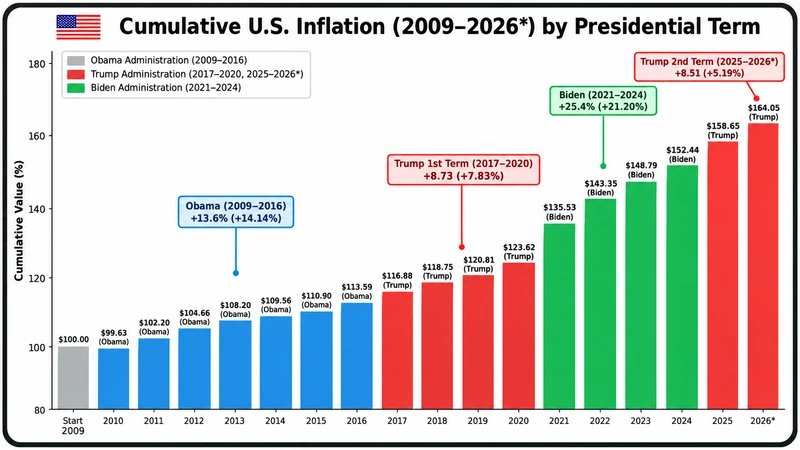
For millions of American households, economic news over the past few years has felt increasingly disconnected from reality. Official reports regularly highlight "cooling" Year-over-Year (YoY) inflation rates—touting drops from frantic peak highs down to single-digit territory—yet the average family budget remains stretched to its limit.
The source of this disconnect is simple: inflation is cumulative, but reporting is ephemeral. A lower YoY inflation rate does not mean prices are falling; it simply means they are rising at a slower pace on top of an already bloated baseline. To understand why living costs feel so heavy, we must examine the shrinking power of the dollar, the catalysts that accelerated price increases during the Biden administration, and the concrete actions the federal government can take to bring prices back down.
The Shrinking Dollar: Pre-COVID vs. Today
To grasp the true impact of inflation, look at the purchasing power of a single hundred-dollar bill. In early 2020, before the onset of pandemic-era economic interventions, a $100 bill commanded a full basket of groceries, a week of commuting fuel, or a comfortable family dinner.
Fast forward to today: that exact same $100 bill buys what roughly $75 to $77 bought in 2019. In real terms, the American consumer has experienced a structural loss of roughly 23% to 25% of their purchasing power in just a few short years.
Because price tags rarely ratchet backward once established, this degradation of purchasing power is a permanent tax on savings. A worker who earned $60,000 in 2019 needed to earn nearly $75,000 by 2024–2025 just to maintain the exact same standard of living. For fixed-income retirees and hourly workers whose nominal wages failed to keep pace, the real-world consequence has been a forced reduction in quality of life.
What Accelerated Inflation During Biden’s Term?
The historic inflation spike that peaked at a 40-year high of 9.1% in mid-2022 was not an accident of nature. It was the predictable outcome of an historic policy collision: massive monetary expansion and unprecedented fiscal stimulus meeting severely constricted supply chains.
Three primary engines accelerated price increases during the Biden administration:
1. Massive Fiscal Stimulus Meets Demand Shock
In March 2021, on top of trillions in previous emergency relief, the Biden administration enacted the $1.9 trillion American Rescue Plan. This legislative package flooded the consumer economy with direct stimulus checks, expanded unemployment bonuses, and monthly child tax credits. Research from the Federal Reserve Bank of San Francisco and economic institutions worldwide confirmed that injecting this level of liquidity directly into household bank accounts created an artificial demand shock, driving consumer spending far beyond the productive capacity of the domestic economy.
2. Supply Chain Congestion and Labor Distortions
While federal stimulus drove consumer demand to record levels, the supply side of the global economy remained crippled. Port bottlenecks, manufacturing backlogs, microchip shortages, and logistics disruptions made goods scarce. Simultaneously, expanded government transfer payments and shifting workplace dynamics created severe labor shortages in trucking, warehousing, and agriculture—forcing businesses to raise nominal wages and pass those increased operational costs directly down to retail price tags.
3. Energy Policy and Global Commodity Shocks
Energy is the foundational input for every physical product and service in the global supply chain. Early regulatory actions targeting domestic fossil fuel development—such as canceling pipeline permits and restricting federal leasing—combined with geopolitical shocks like Russia's invasion of Ukraine in early 2022 to send crude oil and diesel prices soaring. Higher fuel costs immediately trickled down into every step of agriculture, manufacturing, and retail distribution.
Why Has Inflation Remained High and "Sticky"?
Many consumers assumed that once COVID-19 supply bottlenecks cleared and the Federal Reserve raised interest rates, prices would naturally return to pre-pandemic levels. Instead, prices plateaued at their new high baseline.
This structural persistence is driven by two main economic phenomena:
The Ratchet Effect & Contractual Lag: Businesses operate on long-term fixed commitments, including commercial real estate leases, Multi-Year labor agreements, and supplier distribution contracts. Once a grocery store or manufacturer signs contracts reflecting higher baseline costs, those costs become "sticky." Companies cannot lower prices without eroding operating margins or risking insolvency.
Wages and Marginal Costs: To retain workers during the labor shortages of 2021–2023, employers across retail, healthcare, and hospitality raised base pay. Because businesses rarely reduce nominal wages without layoffs, higher payroll costs remain permanently embedded in the price of everyday services.
What Can the Government Do to Lower Prices?
While the Federal Reserve uses interest rate hikes to suppress demand, central banks cannot create goods, extract energy, or streamline supply chains. Achieving true price relief—or even outright price deflation in key essential sectors—requires supply-side economic reform from the executive and legislative branches of government.
Here is what Washington could do to lower living costs for everyday Americans:
1. Unleash American Energy Production
Energy drives the cost of everything from fertilizer to grocery delivery. The federal government could immediately lower baseline production and logistics costs by streamlining energy permitting, expanding domestic oil and natural gas leasing, and easing regulatory hurdles for pipeline construction. Lowering diesel and power prices directly reduces input costs across the entire supply chain.
2. Practice Fiscal Restraint and Cut Deficit Spending
Continued federal deficit spending injects new money into circulation, competing against private sector purchasing power and forcing the Fed to keep borrowing rates elevated. Restraining federal spending and balancing the national budget would reduce the underlying inflationary pressures caused by government borrowing.
3. Cut Onerous Regulations and Red Tape
Extensive regulatory burdens in agriculture, housing construction, and manufacturing act as a hidden tax on consumers. By streamlining environmental review processes (such as NEPA reform) and lifting restrictive local zoning or federal mandates on building materials, the government can drastically reduce the cost of constructing new homes and producing essential consumer goods.
4. Repeal Protectionist Shipping and Trade Restraints
Policies like the 1920 Jones Act—which restricts coastwise domestic shipping to U.S.-built, owned, and flagged vessels—artificially inflate freight costs for domestic commerce, particularly for coastal states and island territories. Modernizing or waiving maritime shipping restrictions and lowering tariffs on key industrial imports would instantly reduce transportation costs across the supply chain.
Final Thoughts
Cooling inflation rates offer little comfort when the baseline cost of living remains permanently elevated. A dollar today simply buys far less than it did five years ago, and nominal wage growth is still fighting to bridge that gap. Until policymakers shift away from demand-side spending and focus on deregulating supply chains, expanding domestic energy, and reining in federal deficits, American families will continue carrying the weight of the dollar’s reduced purchasing power.