The global financial markets enter the first week of June suspended in a state of tense optimism. While major U.S. equity indices continue to drift near historic all-time highs, a dense macroeconomic calendar and an incredibly fluid geopolitical landscape are preparing to deliver a stark reality check to investors worldwide.
1. THE INSTITUTIONAL RADAR: KEY MARKET DRIVERS THIS WEEK
After a period dominated by corporate earnings and speculative momentum, institutional focus is shifting decisively back to structural economic data and central bank policy dynamics. Investors are looking for clarity on whether the domestic economy is landing softly or maintaining too much inflationary heat.
The Labor Market Litmus Test:
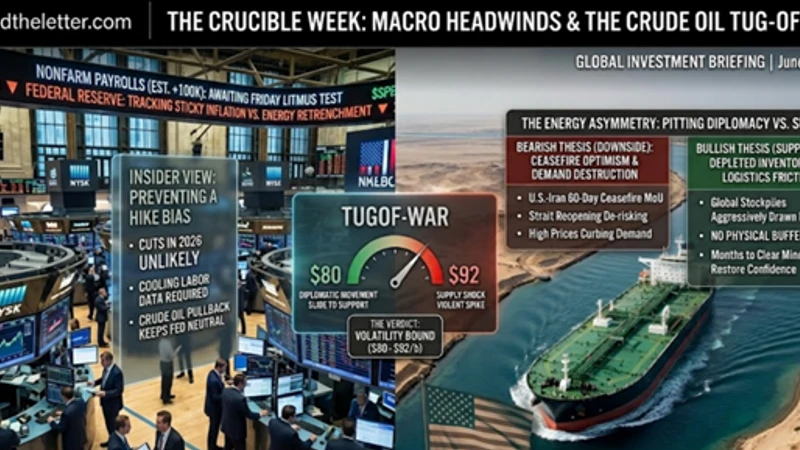
Friday’s upcoming May Nonfarm Payrolls report stands as the week's premier macro catalyst. Consensus estimates project a moderating but resilient gain of approximately 100,000 jobs, with the structural unemployment rate expected to hold steady at 4.3%. For equity markets, a controlled deceleration in hiring is the ideal outcome to alleviate stubborn wage-inflation anxieties.
High-Frequency Macro Data:
Ahead of the payroll data, a wave of secondary indicators will shape sentiment. Markets will dissect the ISM Manufacturing PMI for signs of industrial expansion, alongside the JOLTS job openings, ADP employment metrics, and the Federal Reserve’s latest Beige Book publication. Collectively, these inputs will verify if economic momentum remains overly hot.
The Federal Reserve’s Boundary: Sticky inflation prints from earlier in the year have effectively dismantled investor expectations for near-term interest rate cuts in 2026.
However, the recent sharp retrenchment in global energy prices has successfully suppressed fears of further interest rate *hikes*. Fixed-income and equity desks will carefully parse scheduled commentary from Fed officials this week to confirm if this neutral-to-hawkish consensus remains intact.
2. THE ENERGY NEXUS: DISSECTING THE CRUDE OIL DILEMMA
Crude oil remains the central variable for broader market stability. Following a highly volatile spring that saw Brent crude average $117 per barrel in April—largely driven by the de facto closure of the critical Strait of Hormuz—the energy market is currently undergoing an aggressive relief sell-off.
Crude prices recently endured a sharp weekly decline of nearly 10%, pulling West Texas
Intermediate (WTI) down beneath the $88/b threshold, while global benchmark Brent is hovering precariously between $91 and $92/b. The immediate trajectory of the commodity relies on a high-stakes race between diplomatic progress and physical supply constraints.
THE BEARISH THESIS (DOWNSIDE PRESSURES)
Ceasefire Diplomatic Optimism
The primary catalyst for the recent price liquidation is ongoing diplomatic engagement between Washington and Tehran. Negotiations aiming for a formal 60-day ceasefire extension and the structured reopening of the Strait of Hormuz have prompted systemic de-risking. A finalized Memorandum of Understanding (MoU) could strip remaining geopolitical risk premiums, drifting prices toward the mid-$80s.
Asymmetric Demand Destruction
The extended period of elevated energy costs sustained through the early spring has begun to extract an economic toll. Anecdotal and quantitative demand destruction has emerged globally, effectively forcing a macro-level rebalancing of consumption patterns even amidst constrained global output.
THE BULLISH THESIS (SUPPLY-SIDE SUPPORT)
Severely Depleted Physical Inventories
In direct opposition to diplomatic sentiment are the underlying physical realities of the market. Senior energy executives have repeatedly warned that global crude stockpiles were aggressively drawn down during the peak months of the maritime conflict. This severe lack of physical inventory means the global supply chain possesses virtually no buffer against unexpected shocks.
Friction in the Logistics Rebound Energy
logistics experts note that even under a best-case diplomatic breakthrough, the physical normalization of the Persian Gulf will not be instantaneous. Clearing maritime lanes, neutralizing risks, and restoring commercial shipping confidence to pre-conflict baselines will require months, ensuring a rigid floor under summer baseline prices.
STRATEGIC OUTLOOK & TRADING CORRIDORS
Expect oil markets to exhibit heightened intra-week volatility but remain bound to immediate sideways-to-downward pressure, targeting a functional range between $80 and $92 per barrel. While a finalized diplomatic accord could slide crude toward major structural support near $85,the absolute lack of physical buffer stocks means any sudden friction or breakdown in international talks will trigger an immediate, asymmetric spike back toward the mid-$90s.