We are currently witnessing one of the greatest paradoxes in modern economic history.
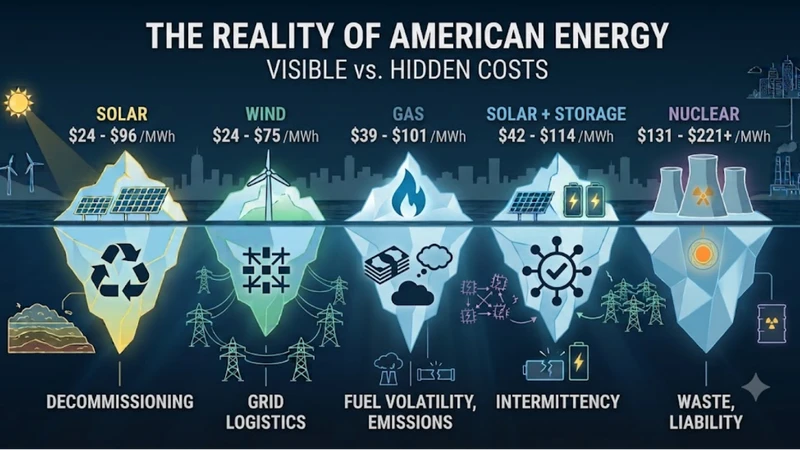
If you look at a spreadsheet from Wall Street or the U.S. Energy Information Administration (EIA), the narrative is clear: generating electricity has never been cheaper. Thanks to massive manufacturing scale, the levelized cost of utility-scale solar and onshore wind has plummeted over the last decade, consistently undercutting coal, nuclear, and even cheap American natural gas.
On paper, a transition to renewables looks like a corporate and consumer slam dunk.
But in the real world, your utility bills are rising, grid operators are warning of rolling blackouts, and tech giants are quietly signing contracts to keep decades-old coal and gas plants running.
What gives? Why isn't the "cheapest" energy on earth showing up in the macro data or consumer wallets?
The answer lies in the friction between spreadsheet economics and physical reality. The American energy landscape is running headfirst into a multi-causal storm driven by exploding demand, logistical bottlenecks, and the massive, hidden long-term structural costs of changing how a nation plugs in.
Here is the reality behind the gridlock.
1. The Human and Digital Demand Shock
For nearly twenty years, American electricity demand was beautifully, predictably flat. Efficiency gains in appliances and lighting perfectly balanced population growth.
Suddenly, that era of stability is dead. The grid is facing a dual-pronged demand shock that is squeezing reserve margins to razor-thin levels:
- The Digital Spike: The explosive rise of AI, machine learning, and cloud computing has triggered a data center gold rush. These facilities don't just use a lot of power; they require massive density. A single hyper-scale data center cluster can consume as much electricity as a mid-sized American city, pulling that power 24/7/365.
- The Human Baseline: At the exact same time, the absolute baseline of the country has expanded. The addition of over 10 million people to the population via recent migration waves has fundamentally altered demand. More people mean more household formations, more commercial spaces, more refrigeration, and more HVAC loads.
Crucially, this human growth isn't evenly distributed. It is heavily concentrated in the Sunbelt, the Southeast, and Texas—the exact regions where blazing summer temperatures make air conditioning a non-negotiable, high-load necessity.
2. The Intermittency Penalty & The Natural Gas Backbone
This soaring demand creates a massive problem for the "cheapest" energy sources. Data centers and hot residential subdivisions cannot pause operations when the sun goes down or the wind stops blowing.
While a standalone solar farm boasts a rock-bottom cost per megawatt-hour, it only operates at a fraction of its total capacity over a 24-hour cycle. To make that power reliable, you have to pair it with massive lithium-ion battery storage arrays. The moment you add four to eight hours of battery capacity to a solar project, the economic math shifts. The "cheapest" energy suddenly carries a premium.
This is why, despite the green transition narrative, natural gas remains the practical, unyielding backbone of the American economy.
Natural gas plants are "dispatchable"—they can be fired up or throttled down in minutes to meet a sudden spike in demand. Because the US is the world’s largest domestic producer of natural gas, our baseline fuel costs are structurally insulated compared to the rest of the world. When the grid gets pushed to the brink during a heatwave, it isn't solar keeping the lights on at 8:00 PM; it’s natural gas.
3. The Physical Toll: Tollroads and Paperwork
Even if you build thousands of acres of cheap solar panels, you face the ultimate bottleneck: logistics.
The cheapest wind energy is generated in the Great Plains; the cheapest solar is in the desert Southwest. But America’s surging data centers and population booms are thousands of miles away.
- The Interconnection Desert: Right now, there are over 2,000 gigawatts of energy projects—mostly renewables and storage—stuck in a regulatory logjam. The average new energy project waits over five years just to get permission from grid operators to plug into the system.
- The Transmission Nightmare: To move power from where it’s made to where it’s needed, we need high-voltage transmission lines. But building a single mile of these lines costs between $3 million and $6.5 million. Worse, crossing state lines requires navigating a legal minefield of private property rights, environmental lawsuits, and local political gridlock. We are building the cars (generation), but we aren't building the highways (transmission).
4. The Blind Spot: Landfill Penalties and the Capex Treadmill
The final—and perhaps most punishing—reality missing from the standard renewable equation is the back-end lifecycle math. Traditional power plants (nuclear and natural gas) are high-concentration, permanent infrastructure assets designed to last between 40 and 80 years. Once their initial construction debt is fully paid off and depreciated, they turn into highly profitable cash cows that only require basic maintenance.
Renewables operate on an entirely different, shorter timeline that forces a massive financial trade-off:
- The Landfill and Disposal Tax: First-generation solar installations and wind farms are hitting their 20-to-25-year lifecycles right now, creating an immediate decommissioning liability. Wind turbine blades—built from heavy fiberglass composites—are incredibly expensive to recycle and are overwhelmingly chopped up and hauled to specialized landfills. Solar panels, containing trace heavy metals like lead and cadmium, increasingly face stringent hazardous waste handling regulations. These soaring end-of-life disposal fees act as a structural back-end tax that drains the profitability of original installations.
- The Capital Reinvestment Treadmill: Because solar panels naturally degrade in efficiency by 0.5% to 1% annually, and grid-scale lithium batteries degrade significantly within 10 to 15 years under heavy daily cycling, a renewable-reliant grid faces a multi-decade capital trap. Rather than enjoying cheap, fully-depreciated baseline energy, utilities are forced onto a permanent capital expenditure treadmill—completely re-purchasing and replacing their entire asset base every 20 to 25 years.
When you extend the time horizon to 50 years, the "free fuel" of wind and solar must absorb two full generations of complete equipment replacement and massive decommissioning liabilities. Conventional power infrastructure requires only one.
The Bottom Line
When assessing the energy sector as an investor, executive, or citizen, we must separate the cost of generation from the cost of delivery and lifecycle maintenance.
Renewables have won the cost war at the source. But until America solves its transmission gridlock, accelerates its regulatory approval pipelines, handles the back-end recycling crisis, and develops cheap, multi-day long-duration storage, the market will continue to pay an extreme premium for reliability.
In an era of exploding digital and human demand, the asset that can guarantee it will deliver power at 2:00 AM during a freeze will always hold the ultimate economic trump card. For the foreseeable future, that reality keeps the old-school commodity complex firmly in the driver's seat.