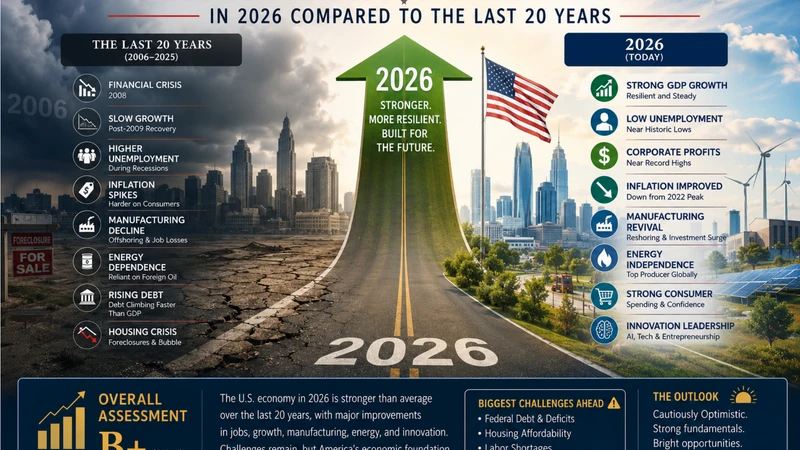
Overall, the U.S. economy in 2026 is stronger than average over the last 20 years in several important ways, but it also has some meaningful weaknesses. If I had to give it an overall grade relative to the past two decades, I'd say:
Overall: B+ (around 8/10)
Here's how it compares across the major categories.
| Category | Compared to Last 20 Years | Comments |
|---|---|---|
| GDP Growth | Above Average | The economy has remained surprisingly resilient despite higher interest rates. |
| Employment | Excellent | Unemployment has stayed historically low for much of the post-pandemic period. |
| Corporate Profits | Very Strong | Many U.S. companies are producing record profits, especially technology and industrial firms. |
| Consumer Spending | Strong | Consumers continue to spend, although growth has moderated. |
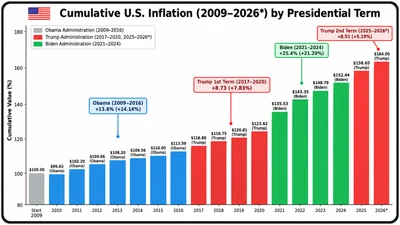
| Inflation | Improved | Inflation has fallen dramatically from the 2022 peak but remains above the Fed's long-term target. |
| Manufacturing | Strongest in Decades | Domestic manufacturing investment has surged thanks to reshoring, AI infrastructure, semiconductors, and energy. |
| Energy | Excellent | The U.S. remains one of the world's largest energy producers. |
| Federal Debt | Poor | This is arguably the economy's biggest long-term weakness. Debt has grown much faster than GDP. |
| Housing Affordability | Poor | High home prices combined with elevated mortgage rates have created one of the least affordable housing markets in decades. |
| Productivity | Improving | AI adoption and business investment are beginning to boost productivity growth. |
Why the economy has outperformed expectations
Many economists expected a recession after the Federal Reserve raised interest rates aggressively beginning in 2022. Instead:
- Businesses adapted.
- Consumers kept spending.
- Companies continued hiring.
- AI investment accelerated.
- Energy production remained strong.
- Manufacturing returned to the U.S. in several strategic industries.
That combination helped avoid the recession many had predicted.
Compared with key periods over the last 20 years
2008–2010 (Financial Crisis):
- Today's economy is dramatically stronger.
- Banks are healthier.
- Employment is much higher.
- Consumer confidence is stronger.
2011–2019 (Expansion):
- Growth is similar or slightly better.
- Wages have risen faster.
- Manufacturing investment is considerably stronger.
- Interest rates are higher today.
2020 (COVID):
- No comparison—the economy is far healthier now.
2021–2022 (Inflation Surge):
- Inflation was a major problem then.
- Today inflation is much lower while economic growth has continued.
The biggest strengths today
The U.S. has several structural advantages:
- AI leadership
- Deep capital markets
- Strong entrepreneurial ecosystem
- Energy independence relative to many peers
- World-leading technology companies
- Continued global demand for U.S. assets and the U.S. dollar
These advantages help explain why international investors continue to direct capital into U.S. markets.
The biggest risks
Several challenges could weigh on long-term growth:
- Federal deficits and rising interest costs on the national debt.
- Housing affordability, especially for younger buyers.
- Labor shortages in skilled trades and certain professional fields.
- Potential geopolitical disruptions affecting trade and supply chains.
My overall assessment
Looking at the economy over the last 20 years—not just the stock market—I would rank today's U.S. economy among the strongest top 20–30% of that period.
It's not perfect. Housing affordability and federal debt are significant concerns, and those issues could constrain long-term growth if left unaddressed. However, the combination of low unemployment, resilient consumer spending, robust corporate earnings, renewed manufacturing investment, and rapid AI-driven innovation makes the current economy considerably healthier than many expected after the inflation shock of 2022.
For investors, one important distinction is that a strong economy does not automatically mean stocks will continue rising at the same pace. Markets often price in good news well before it appears in economic data. History shows that disciplined investing, diversification, and focusing on long-term fundamentals remain more reliable strategies than trying to chase short-term economic momentum.