In the world of economics, transparency is often touted as a virtue. Yet, within the United States tax system, a phenomenon exists that remains largely invisible to the average consumer: Tax Cascading. Also known as “tax pyramiding,” this process quietly inflates the price of goods by stacking taxes upon taxes throughout the journey from raw material to retail shelf.
What is Compounded Taxation?
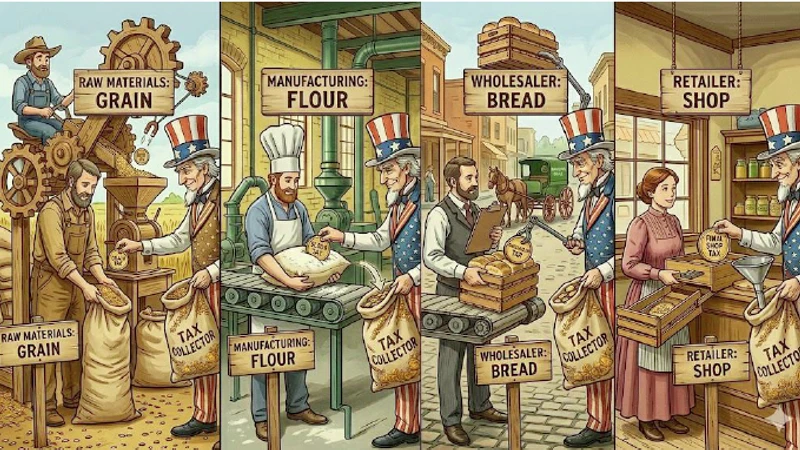
Compounded taxation occurs when a tax is imposed on a product at every stage of its production and distribution. Unlike a transparent sales tax—which is intended to be a single-stage levy on the final consumer—cascading taxes embed themselves into the cost of doing business. Because each subsequent handler of the product pays tax on a price that already includes the previous stage’s tax, the final burden is significantly higher than the nominal tax rate suggests.
The Mechanics of the Cascade
1. Tax on Input Costs
When a manufacturer purchases raw materials, they often pay sales tax. To maintain profit margins, that tax is not simply “paid”; it is incorporated into the cost of the finished product. When a wholesaler buys that product, they pay tax on a price that is already artificially inflated by the manufacturer’s tax. This cycle repeats until it reaches the consumer.
2. The Lack of Input Credits
This is where the US system differs from some international models. In many US state sales tax regimes, credits are unavailable for various intermediate goods or services, ensuring the “pyramid” continues to grow.
3. Internal Consumption and Use Tax
Compounding isn’t limited to external sales. If a business pulls from its own inventory for internal operations, many states trigger a “use tax.” This effectively taxes the business for using its own resources, adding another layer of cost that must eventually be recovered through higher pricing for customers.
Case Study: The $330 Effect
Consider a simplified supply chain with a 10% tax rate at every level:
- Raw Material: Cost $100 + 10% tax = $110.
- Manufacturer: Processes the material and sells to a wholesaler. Price is $200 (including previous tax) + 10% tax = $220.
- Retailer: Buys from the wholesaler and sells to the final consumer for $300 (including previous taxes) + 10% tax = $330.
In this scenario, the consumer isn’t just paying tax on the item; they are paying tax on the taxes paid by the manufacturer and the wholesaler.
Cascading vs. Single-Stage Tax
| Tax Type | Application | Economic Impact |
|---|---|---|
| Cascading Tax | Charged at every stage of production. | Higher consumer prices; favors large, vertically integrated companies. |
| Single-Stage Tax | Applied only at the final retail sale. | Transparent; reflects the actual intended tax rate. |