If you looked at the jobs report this morning and immediately reached for the panic button, I wouldn't blame you.
The headline wasn't exactly encouraging.
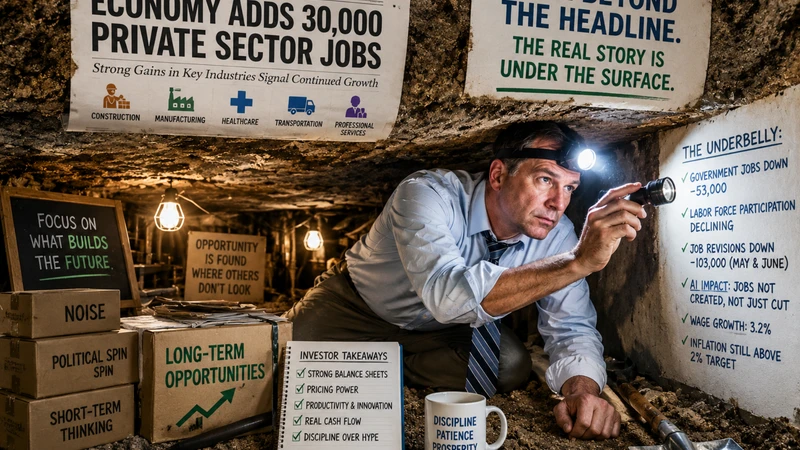
The U.S. economy lost 23,000 jobs in July when economists were expecting a meaningful gain. Then came the revisions, which made the picture even worse. May and June were revised down by a combined 103,000 jobs.
So much for those earlier reports telling us everything was just fine.
But here's where I think investors need to slow down and look past the headline.
Because the story underneath the numbers is considerably more interesting.
For starters, the private sector actually added 30,000 jobs in July. The big decline came from government employment, which fell by 53,000 jobs. Construction added 22,000. Manufacturing added jobs. Transportation and warehousing added nearly 10,000. Professional and business services added 18,000.
Healthcare continues to be one of the strongest areas of employment.
In other words, this doesn't look like businesses everywhere suddenly turning off the lights and sending everybody home.
It looks more like an economy that is getting increasingly selective about hiring.
And that brings me to the part of this report that I think investors should be watching very closely: AI.
I'm not suggesting AI caused the July jobs number. That would be taking the data much further than it goes.
But something is changing in the way American businesses think about employees.
For years, a growing company generally meant hiring more people. More customers meant more customer-service employees. More transactions meant more accounting staff. More marketing meant more people producing content. More data meant more analysts.
AI is starting to mess with that formula.
A company can now have the same number of employees handling considerably more work. A business that might have hired five people a few years ago may decide that three very good employees equipped with the right technology can do the job.
Nobody necessarily gets fired.
Two jobs simply never get posted.
And that distinction is important because the monthly jobs report isn't designed to tell us how many jobs companies decided not to create.
We're beginning to see some evidence of this happening, however. Challenger, Gray & Christmas says artificial intelligence has been cited as the leading reason for announced job cuts for five consecutive months.
Again, that doesn't mean AI is destroying the American labor market.
It means the economics of hiring are changing.
And for investors, that could turn out to be one of the most important investment themes of the next several years.
Think about what happens when a company can increase revenue without increasing payroll at the same rate.
Margins improve.
Profitability improves.
Cash flow improves.
And eventually, shareholders notice.
This is why I think the next phase of the AI story is going to be much more interesting than the first.
We've spent the last couple of years talking about who has the biggest AI model, who has the fastest chips and who is spending the most money building data centers.
That's the easy part.
Now comes the harder question:
Who is actually making money because of AI?
That's where I want to spend my time as an investor.
But today's jobs report also gives the Federal Reserve something else to think about.
The Fed has been caught between two problems for quite a while now. Inflation remains higher than it wants, while the labor market is clearly losing some momentum.
That's not exactly a comfortable position.
It's like driving down the highway while pressing the gas and brake at the same time.
At its July meeting, the Fed left interest rates unchanged at 3.50% to 3.75%. Interestingly, three Fed officials wanted to raise rates another quarter point.
Today's jobs report makes that position considerably harder to defend if employment continues to weaken.
But I wouldn't assume this means the Fed is suddenly going to slash rates.
Inflation is still sitting there staring at them.
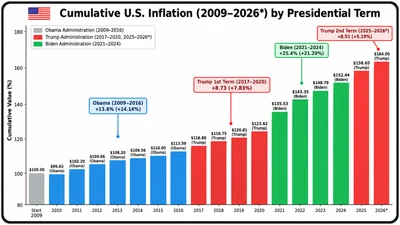
The Fed's target is 2%, and we're not there yet. Wage growth is still running around 3.2% year over year.
So the Fed has to ask a rather annoying question: Is the economy weakening enough to justify lower rates, or is inflation still sticky enough that cutting too soon could make the problem worse?
That's why the next couple of inflation reports and the August jobs report are going to matter so much.
For investors, I think the lesson is fairly simple.
Don't panic.
But don't ignore the warning signs either.
The economy isn't booming the way it was a couple of years ago. The three-month average of job creation has fallen dramatically, labor-force participation has weakened, and the downward revisions tell us the labor market wasn't as strong as we originally thought.
At the same time, private companies are still hiring.
Construction is hiring.
Manufacturing is hiring.
Healthcare is hiring.
And businesses are increasingly figuring out how to do more with fewer people.
That last one may ultimately be the most important.
Republican investors, in particular, should pay attention to the productivity side of this story.
We spend a lot of time talking about government spending, taxes, regulation and interest rates — and those things matter. But America's greatest economic advantage has always been its ability to produce more, innovate faster and turn technology into higher productivity.
AI could be the next major productivity leap.
If it is, the winners won't necessarily be the companies with the most impressive AI press releases.
They'll be the companies that quietly use AI to cut costs, increase output, improve customer service and generate more cash.
That's a much less glamorous story.
And probably a much better investment story.
The jobs report also reinforces something I've said before: this is not an environment where I want to blindly chase whatever is going up.
I want companies with strong balance sheets, real cash flow, pricing power and management teams that know how to operate when money isn't free.
If rates eventually come down, those companies can benefit.
If rates stay higher, they're better positioned to survive.
If AI takes off, they can use it to improve margins.
And if the economy slows further, they're not relying on cheap money to stay alive.
That's what I'd call having a few arrows in the quiver.
So, is today's jobs report bad?
Yes.
Is it a reason to assume we're heading into a recession?
I don't think we're there yet.
Is the labor market weaker than we thought?
Absolutely.
And is AI beginning to change the relationship between economic growth and job creation?
I think the evidence is increasingly pointing in that direction.
That's the bigger story I'm watching.
For decades, investors have operated on the assumption that economic growth and employment growth generally move together.
AI could start breaking that relationship.
We could eventually have an economy that produces more, earns mo