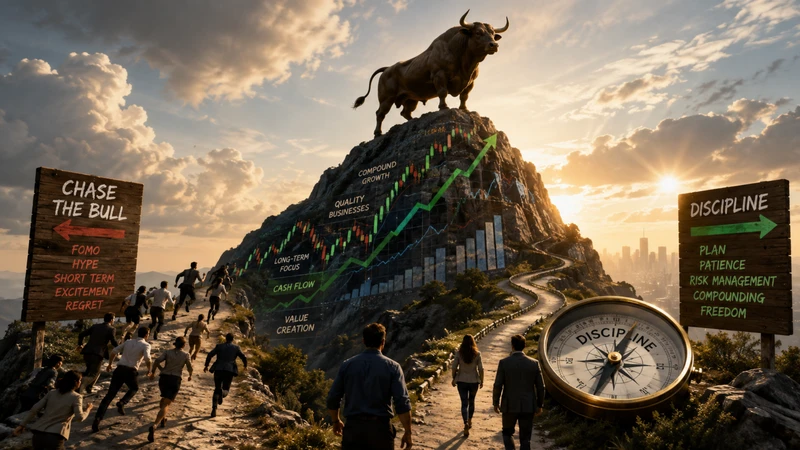
There is an old saying on Wall Street that bull markets climb a wall of worry. Eventually, however, they stop climbing—and almost no one knows exactly when that moment will come.
After months of strong gains, it's easy to feel like investing has become effortless. Portfolios are growing, retirement accounts are recovering, and every financial news program seems to feature another expert explaining why this rally is only getting started. It's human nature to believe that what has been happening recently will continue indefinitely.
History suggests otherwise.
That doesn't mean investors should fear every new market high or run for the sidelines. In fact, trying to predict the next correction has probably cost investors more money than the corrections themselves. What it does mean is that periods of optimism are often the best time to revisit the principles that create long-term wealth.
When markets are soaring, discipline matters more than enthusiasm.
One of the most common mistakes investors make during a bull market is selling great companies simply because they've appreciated. There's a temptation to "lock in gains," even when nothing meaningful has changed about the underlying business.
A better question is this: Has the reason I bought this company changed?
If the answer is no, why sell it?
Many of America's greatest investment fortunes weren't built by constantly buying and selling. They were built by identifying exceptional businesses, allowing talented management teams to execute their strategies, and then giving those companies years—not months—to compound. Time is one of the few advantages available to every investor, yet it's often surrendered in exchange for short-term excitement.
At the same time, letting winners run doesn't mean ignoring your portfolio altogether.
Strong rallies naturally create imbalances. A technology position that represented 15 percent of a portfolio a year ago may now account for 30 percent or more. That isn't necessarily a problem, but it may expose you to more risk than you originally intended.
Rather than making dramatic changes based on headlines, consider whether your portfolio still reflects your investment objectives. Trimming positions that have become disproportionately large and reallocating capital into sectors that have lagged isn't market timing—it's simply prudent portfolio management.
Another overlooked advantage during good times is maintaining liquidity.
Many investors view cash as an unproductive asset because it doesn't participate fully in a rising market. But cash serves another purpose that often becomes obvious only after markets decline.
Cash provides options.
Every correction creates opportunities to purchase outstanding businesses at prices that weren't available just weeks earlier. Investors who have available capital during periods of panic can often acquire quality assets while others are forced to sell. In that sense, cash isn't simply sitting idle—it's strategic flexibility waiting for the right opportunity.
It's also worth remembering that wealth isn't created exclusively on public exchanges.
While television commentators focus almost entirely on publicly traded stocks, many sophisticated investors quietly diversify into private businesses, commercial real estate, private credit, energy infrastructure, and carefully selected startup investments. These opportunities often behave differently than the stock market and can provide diversification that many retail investors overlook.
Public markets dominate the headlines.
Private markets often build fortunes quietly.
Every bull market also produces a "can't miss" story.
Today's headlines revolve around artificial intelligence. A few years ago it was cryptocurrency. Before that it was cannabis, SPACs, clean energy, internet stocks, or housing. Some of these industries ultimately reshape the economy. Many of the companies that capture the early headlines, however, never become lasting winners.
Successful investing isn't about buying whatever dominates the news cycle. It's about identifying businesses that generate real revenue, produce sustainable cash flow, maintain competitive advantages, and are led by management teams capable of executing over many years.
Stories attract attention.
Businesses create wealth.
Perhaps the most difficult discipline during a strong market is continuing to invest consistently. When prices are rising, everything feels expensive. Investors begin waiting for "the next pullback" that never seems to arrive. Unfortunately, many remain on the sidelines while the market continues higher.
The reality is that no one rings a bell at the top, and no one rings a bell at the bottom. Investors who continue adding capital through both good markets and bad generally outperform those trying to perfectly time every entry point. Consistency has a remarkable way of outperforming prediction over long periods of time.
Ultimately, it's worth asking why you're investing in the first place.
Your portfolio isn't meant to provide daily entertainment or validation that today's headlines were correct. It's a tool designed to achieve something much larger—financial independence, retirement security, generational wealth, charitable giving, or the ability to invest in America's next generation of entrepreneurs.
Those goals don't change simply because the market has enjoyed a strong quarter.
Bull markets are exciting, and there's nothing wrong with appreciating strong returns. But they also have a way of convincing investors that risk has disappeared and easy money is normal. Experience teaches otherwise.
Markets will continue to rise, correct, recover, and surprise us. Headlines will shift. New technologies will emerge. Political winds will change.
The one constant is human nature.
Investors who remain disciplined when everyone else becomes emotional are usually the ones who arrive at their financial destination first.