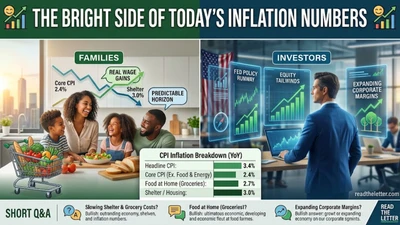
Recent readings across real gross domestic product (GDP) growth, stabilizing inflation benchmarks, and steady job creation paint a clearer macro picture: the broad economy continues to display unexpected resilience. For market participants who spent much of the past cycle bracing for a downturn, this shift in momentum demands a shift in posture.
A favorable GDP trajectory doesn’t simply mean "buy equities." Rather, it marks a transition point in the economic cycle where strategic capital allocation becomes paramount. As corporate balance sheets stabilize and demand holds, here is how forward-thinking investors should position their portfolios for the next phase of growth.
1. The Re-Expansion Phase: Broadening Market Breadth
In the early stages of economic resilience, broad market indices are often driven by a concentrated handful of large-cap tech or defensive leaders. However, sustained GDP growth serves as the foundation for broader sector participation.
Look Beyond Mega-Caps: As enterprise spending and consumer confidence solidify, mid-cap and high-quality small-cap equities often present attractive valuation gaps relative to their mega-cap peers.
Cyclicals with Pricing Power: Industrial, infrastructure, and commercial expansion sectors typically see renewed capital expenditure (CapEx) when economic confidence rebounds. Focus on companies with high return on invested capital (ROIC) and low balance sheet leverage.
2. Navigating the Interest Rate & Yield Curve Evolution
A healthy GDP environment changes the federal interest rate trajectory. Instead of emergency rate cuts to stave off economic contraction, monetary policy shifts toward normalization.
Fixed Income Duration: In a stable growth environment, high-yield spreads narrow, and fixed income returns transition back to coupon-yield clipping rather than rapid capital appreciation. Short-to-intermediate duration high-grade corporate bonds and private debt offer compelling risk-adjusted yields without taking on excessive rate-sensitivity risk.
Real Assets as Real Shields: Even when inflation moderates, economic growth drives demand for tangible inputs. Strategic allocation to energy infrastructure, commodities, and select commercial real estate provides both an inflation hedge and yield production.
3. Private Credit & Alternative Yield Dynamics
As institutional lenders maintain prudent underwriting standards post-rate spike, alternative financing markets have expanded rapidly to meet middle-market corporate demand.
Private credit—particularly direct lending and asset-backed financing—continues to deliver premium risk-adjusted returns compared to liquid public debt markets.
For qualified accredited investors, participating in private capital vehicles provides exposure to non-correlated, cash-flowing underlying assets that thrive during economic expansions.
The Bottom Line
Positive GDP and strong fundamental indicators are an invitation to rebuild offensive positions—not through speculative momentum, but through disciplined allocation to cash-flowing, high-efficiency businesses and alternative yield engines.