The promise of Small Modular Reactors (SMRs) has been one of the most intoxicating narratives in the energy and tech sectors this year. The pitch is undeniably attractive: factory-built, scalable, and dispatchable zero-carbon energy. But this week, the SMR sector is providing a harsh masterclass in the difference between scientific viability and commercial readiness.
Here is what you need to know about the recent breakthroughs, the brutal market correction, and what this means for the broader technology infrastructure landscape.
The Scientific Breakthrough is Real
First, it is important to acknowledge that the science is advancing. Over the past two months, startups like Antares Nuclear, Valar Atomics, and Aalo Atomics successfully completed "zero-power fueled criticality" demonstrations at the Idaho National Laboratory.
Backed by the Department of Energy, these tests are significant. They proved that the core physics and novel reactor designs can operate safely and sustain a nuclear reaction. However, these were "dry" research tests—meaning they lacked the cooling systems and turbines required for actual power generation. They proved the physics, not the commercial power plant.
The Investment Fallout: A $30 Billion Haircut
The market, having aggressively bought the rumor of an impending nuclear renaissance, is now selling the reality of the timeline.
The SMR sector is currently experiencing a severe deflation of its hype cycle:
Massive Valuation Drops: Over $30 billion in collective market capitalization has been wiped out from leading SMR companies, including NuScale Power, Nano Nuclear, Oklo, and X-energy, since their recent peaks.
The Short Sellers' Victory: Institutional skepticism has paid off heavily, with short sellers reaping over $2 billion in profits in just the last week as these stocks cascaded downward.
The Revenue Problem: Investors are waking up to a stark fundamental reality. These startups are heavily capital-intensive, posting significant operating losses and burning through cash, all while generating effectively zero commercial revenue.
The Timeline Reality and Datacenter Growth
The core catalyst for this correction is the market's realization of the commercial timeline. Validating the physics in a government lab is a monumental achievement, but navigating the Nuclear Regulatory Commission (NRC), building commercial supply chains, and commissioning actual grid-connected power plants is still a decade away.
This timeline reality introduces a massive bottleneck for the artificial intelligence boom.
Hyperscalers and tech giants have been banking on SMRs to provide the massive, continuous "baseload" power required to run next-generation AI data centers. With SMR deployment pushed further into the 2030s, the datacenter growth trajectory faces a critical challenge. To meet near-term power demands, tech companies will likely be forced to pivot their capital toward grid upgrades, advanced geothermal, or fall back on natural gas to bridge the gap, potentially slowing the speed at which massive gigawatt-scale AI facilities can be brought online.
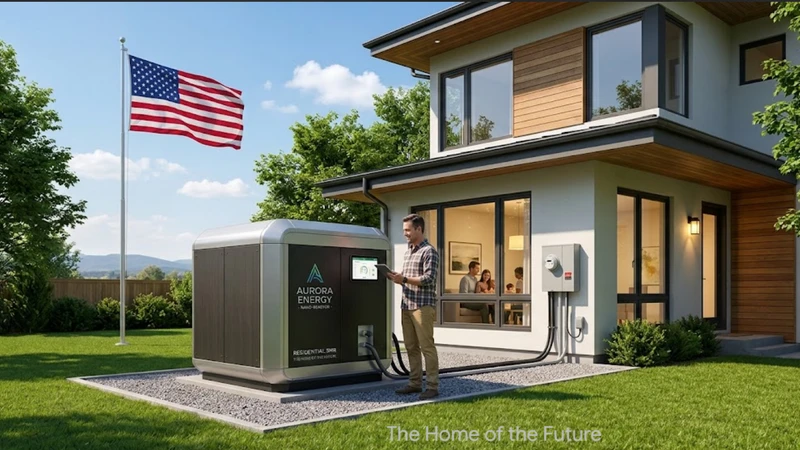
The Micro-Reactor Question: Can an SMR power a house?
With all this talk of "small" modular reactors, a natural question arises: just how small can they get? Could we see a neighborhood or even a single-family house powered by its own backyard reactor?
Scientifically, yes; commercially and logistically, no.
SMRs are currently designed to produce tens to hundreds of megawatts—enough to power industrial facilities, data centers, or small cities. There is a sub-class of technology called "microreactors" designed to produce 1 to 20 megawatts, intended for remote mining operations or military bases.
However, a standard American home only uses a few kilowatts of power. Scaling a fission reactor down to the size of a home appliance introduces insurmountable economic and regulatory hurdles. The cost of security protocols, nuclear fuel handling, NRC licensing, and waste management for a single residential unit would be astronomical. While Radioisotope Thermoelectric Generators (RTGs) exist for highly specialized, small-scale power (like the Mars rovers), the idea of a residential "fission battery" remains purely science fiction for the foreseeable future.
The Bottom Line
For investors, the SMR sector is transitioning from a venture-capital mindset to a public-market reality. The technology is legitimate and will likely play a crucial role in our energy future, but the bridge from lab breakthroughs to positive cash flow is long, expensive, and fraught with regulatory friction.