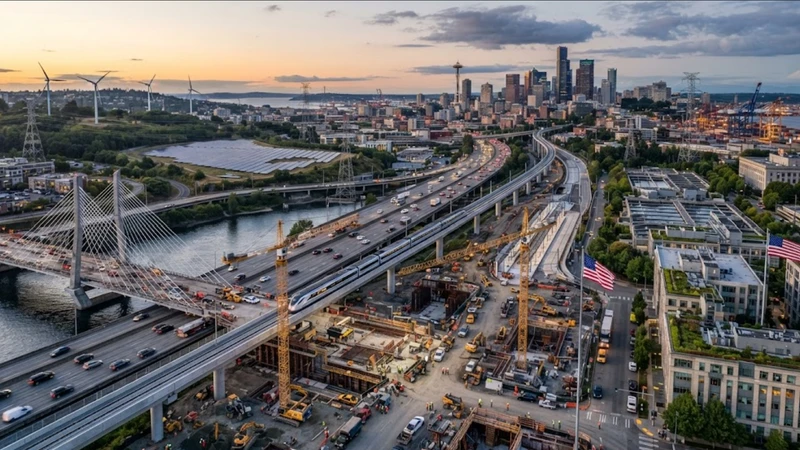
For the past few years, headlines have been dominated by the massive legislative injections into the American landscape—from the Infrastructure Investment and Jobs Act (IIJA) to the CHIPS Act and the Inflation Reduction Act. Trillions of dollars are earmarked for rebuilding crumbling highways, expanding broadband, upgrading the power grid, and reshoring domestic semiconductor and green-energy manufacturing.
If you are a traditional investor, your first instinct is likely to look at heavy machinery, cement producers, engineering giants, and steel manufacturers. And you wouldn’t be wrong; those sectors are seeing robust order books.
However, looking strictly at the direct builders misses a much larger, and often more lucrative, secondary ecosystem. The "picks and shovels" of the infrastructure buildout extend far beyond the job site. From specialized logistics and workforce training to automation software and localized real estate, these ancillary investments are quietly capturing massive cash flows as the physical transformation of America takes shape.
Here is a look at where the smart money is flowing beneath the surface of the headline-grabbing projects.
1. Specialized Logistics and Heavy Hauling
You can manufacture a 100-ton transformer or massive pre-stressed concrete beams, but getting them to a remote job site is an entirely different logistical nightmare.
Standard freight doesn't cut it when your cargo requires specialized multi-axle trailers, police escorts, and route surveys to avoid low bridges and weak rural culverts. Furthermore, regulatory hurdles, permitting, and state-by-state compliance make heavy-haul logistics a heavily guarded moat. Companies providing specialized flatbed transport, heavy-lift rigging, and crane services are operating at peak utilization rates, and their pricing power remains exceptionally strong.
2. Digital Twins, Project Management Software, and Engineering Tech
Modern infrastructure is not just built with muscle; it is engineered with software. Delays and budget overruns have historically plagued large-scale public works. Today, general contractors and government agencies are heavily investing in software solutions that offer real-time tracking, AI-driven supply chain forecasting, and "digital twins"—virtual replicas of physical assets used to simulate stress, maintenance cycles, and operational efficiency before a single shovel hits the dirt.
As the complexity of projects increases—particularly with high-tech data centers, advanced manufacturing plants, and smart grid upgrades—proprietary construction tech and asset-management platforms have shifted from "nice-to-have" tools to absolute mission-critical necessities.
3. Aggregate Testing, Geotechnical Engineering, and Compliance
You cannot pour millions of tons of concrete or lay massive foundations without rigorous testing. Geotechnical engineering firms and materials testing laboratories ensure that soil stability, asphalt mixtures, and concrete integrity meet strict federal and state safety standards.
Because government contracts carry steep liabilities for structural failure, spending on quality assurance, environmental impact studies, and compliance consulting is non-negotiable. These businesses operate on sticky, recurring-revenue models, often locked into multi-year municipal and state contracts that insulate them from short-term economic fluctuations.
4. Industrial Real Estate and "Last-Mile" Aggregates
The location of infrastructure projects has sparked a localized real estate boom. To minimize transportation costs and carbon footprints, concrete batch plants, aggregate quarries, and equipment staging yards need to be relatively close to major urban corridors and project sites.
Industrial landowners and localized real estate investment trusts (REITs) holding strategically positioned parcels—especially those zoned for heavy industrial use or near major shipping hubs and newly announced manufacturing plants—are seeing surging lease rates.
The Bottom Line
The US infrastructure buildout is a multi-decade marathon, not a sprint. While cyclical shifts can create volatility for primary builders, the ancillary sectors—those providing the software, logistics, testing, and specialized services—often offer steadier compounding growth and higher margins. Looking past the obvious concrete suppliers just might uncover the portfolio anchors of the decade.