The venture capital and private equity landscape of 2026 is currently dominated by the “AI Arms Race.” While massive capital continues to flow into large-scale computing and foundational models, the most significant returns are often found in the “blind spots”—the essential sectors that support new technologies or solve the massive inefficiencies they create.
For investors looking beyond the crowded trades of LLMs and consumer apps, these three domains represent massive, untapped opportunities.
1. The Industrial Circular Economy: The “Internet of Waste”
While “sustainability” was once a marketing buzzword, it has evolved into a logistical necessity. Global supply chain fragility has forced a shift from a linear “take-make-dispose” model to a high-tech circular economy.
By treating waste as a high-margin inventory asset, companies are finding billions in “lost” value. The integration of IoT and blockchain ensures the provenance and quality of recovered materials, making secondary markets as reliable as primary ones.
2. AI TRiSM: The Defensive Shield
We have entered the era of agentic AI, where autonomous systems handle real-world workflows like insurance claims and procurement. However, as the “offensive” capabilities of AI grow, so does the liability risk.
AI Trust, Risk, and Security Management (AI TRiSM) is the specialized field of ensuring AI models remain compliant, fair, and secure. This includes Deepfake Defense—tools that can verify the authenticity of audio and video in real-time—and automated governance layers that prevent models from “hallucinating” legal or financial disasters.
While the market for AI generation is saturated, the market for AI protection is just beginning to scale. Enterprise-grade security for the AI stack is no longer optional; it is a prerequisite for deployment.
3. The Nuclear Renaissance: Decentralized Power
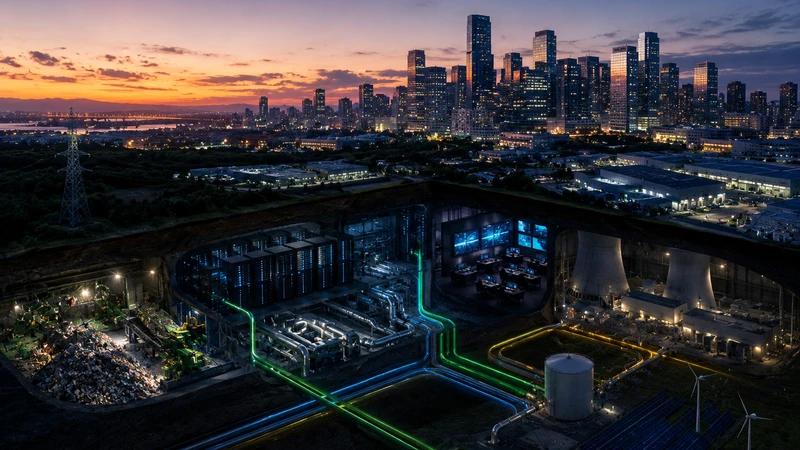
The bottleneck for the next decade of digital growth isn’t just chips; it’s power. With the aging public grid struggling to keep up with the exponential energy demands of AI data centers, the focus has shifted toward Small Modular Reactors (SMRs) and private microgrids.
Investors are moving past public utility plays toward decentralized energy systems. By integrating private, small-scale nuclear power or advanced microgrids directly into industrial sites and data centers, companies can bypass the grid entirely. This ensures 100% uptime and price stability, turning energy from an operating expense into a strategic moat.