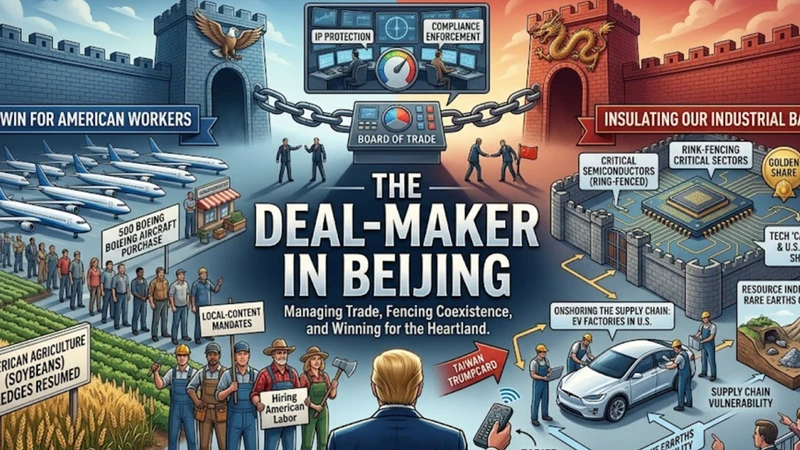
President Trump’s high-stakes visit to Beijing alongside a delegation of America’s top industry leaders marks a decisive turning point in global trade. For years, the Washington establishment pursued a flawed policy of trying to "reform" China’s state-run economy through endless bureaucracy. President Trump is entirely rewriting that playbook.
This summit isn't about globalist integration or polite diplomacy; it is a masterclass in economic nationalism and hard-nosed transactional pragmatism. Coming off a bruising period of necessary tariff pressure, the administration is leveraging American economic dominance to secure major, tangible wins for domestic industries while forcing Beijing to the negotiating table.
Here is the breakdown of what is being delivered, along with the critical, under-the-radar nuances that sharp investors and corporate boards must watch.
1. The Main Event: Massive Commercial Wins and Managed Trade
The public-facing deliverables of this trip are designed to put points on the board for the American worker and revitalize domestic manufacturing.
- The Return of the Purchasing Playbook: Expect blockbuster announcements on a massive scale. The administration is securing firm commitments from Beijing to resume historic levels of American agricultural purchases—a massive win for Heartland farmers—alongside a rumored mega-purchase of roughly 500 Boeing commercial aircraft to boost American aerospace.
- The "Board of Trade" Framework: Moving away from unpredictable, ad hoc trade spats, the administration is establishing a formalized, joint Board of Trade. This isn't a regulatory body; it’s an institutional framework designed to strictly manage trade imbalances, enforce compliance, and protect American intellectual property in real time.
- Energy Security Amid Global Chokepoints: With the ongoing conflict in the Middle East threatening global energy corridors and the Strait of Hormuz facing persistent instability, Trump holds a position of immense leverage. The U.S. is aggressively pressuring Beijing to immediately halt its illicit purchases of Iranian oil, effectively cutting off funds to hostile regimes while stabilizing global energy markets.
2. The Strategic Nuances to Watch Behind Closed Doors
While mainstream media headlines will focus strictly on the multi-billion-dollar price tags of the trade deals, the long-term market implications lie in how the administration is structurally rewiring our economic defenses.
The Death of "Fair Trade" and the Rise of "America First" Protectionism For decades, the standard bipartisan consensus was to push China toward free-market capitalism. The Trump administration has completely discarded that naive goal. Recognizing that Beijing will never abandon its state-led model, the U.S. strategy has shifted toward aggressive defensive insulation. The administration is utilizing heavy state intervention of its own—taking equity stakes in critical semiconductor companies, securing "golden shares" in domestic manufacturing, and demanding profit-splits on export licenses. The goal is no longer to fix China's economy, but to securely ring-fence and protect the U.S. industrial base.
The Tech Titan Delegation and Strategic "Carve-Outs" The inclusion of heavyweights like Elon Musk and Jensen Huang in the delegation underscores a sophisticated approach to advanced technology. While the U.S. maintains a ironclad grip on national security restrictions for top-tier AI and semiconductors, these tech leaders are negotiating highly specific "carve-outs." Companies like Nvidia are looking to maintain access to the massive Chinese commercial market, but under strict U.S. terms—potentially structured so that a direct percentage of these foreign commercial profits flows straight back to the U.S. Treasury, or is legally bound to fund new advanced manufacturing plants on American soil.
Onshoring the Supply Chain: The EV Bargaining Chip In an incredibly bold move, the administration is turning China's electric vehicle dominance on its head. Rather than a blanket ban on Chinese EV giants like BYD, the U.S. is leveraging market access as a weapon. The message to Beijing is clear: if you want to sell to American consumers, you will build your factories here, invest in American communities, and hire American labor. Watch for a formalized framework regarding these mandatory joint-venture manufacturing plants.
The Rare Earths Leverage A critical backdrop to this summit was China’s aggressive attempt to choke off shipments of rare earth minerals—vital to our automotive, tech, and healthcare sectors—in retaliation for U.S. tariffs (which currently average a stiff 47%). This move backfired by accelerating the U.S. push for resource independence. Trump is utilizing the current tariff pressure to force Beijing into guaranteeing stable, long-term access to these critical materials as a condition for any phased tariff relief.
The Taiwan Trump Card Geopolitically, the administration is playing its cards close to the chest. While President Xi has issued fierce warnings behind closed doors regarding U.S. arms sales to Taiwan, Trump’s public posture remains masterfully transactional and ambiguous. By keeping the focus squarely on domestic economic deals and refusing to get bogged down in predictable geopolitical rhetoric, the administration is effectively using the timing and deployment of authorized Taiwanese weapons packages as maximum leverage to extract deeper economic concessions from Beijing.