When a private company's valuation crosses the $200 billion threshold, any sensible investor should immediately put their guard up. In the private markets, hyperbole is cheap, and capital destruction is often disguised as "disruption."
To the casual observer, SpaceX looks like a quintessential vanity project fueled by cheap money and relentless hype. Marquee projects like Starship—a rocket taller than the Statue of Liberty undergoing dramatic test flights over south Texas—resemble expensive science experiments rather than high-yield commercial assets.
But if you look past the headlines and strip away the sci-fi noise, a very different corporate entity emerges. SpaceX isn't just a rocket launch business; it is a vertically integrated data infrastructure monopoly.
To understand why institutional investors are backing this valuation, you have to look at the dual-engine business model that turns rocket boosters into cash flow generators.
Engine 1: The High-Margin Utility (Starlink)
The foundational mistake most analysts make is evaluating SpaceX purely as a transport company. Launching payloads for NASA and commercial satellites is a solid, cash-flow-positive business, but it doesn't scale infinitely. High-volume, recurring subscription revenue does.
Enter Starlink. SpaceX has quietly built a global telecom infrastructure asset in Low Earth Orbit (LEO). By deploying thousands of small, interconnected satellites, they have captured a highly lucrative, inelastic market:
- The Connected Enterprise: Shipping conglomerates, commercial aviation fleets, and oil rigs can no longer operate without high-speed, low-latency data. Starlink charges premium enterprise rates to these industries, where connectivity directly impacts operational efficiency.
- Sovereign & Defense Contracts: Under the "Starshield" banner, SpaceX is securing massive, high-margin defense contracts. Governments are paying premium rates for secure, redundant, space-based communications networks that are nearly impossible to disrupt.
- The Unserved Consumer: Millions of households globally live completely outside the footprint of fiber-optic or reliable cellular networks. Starlink converts these remote regions into high-margin monthly subscribers.
Engine 2: The Moat of Reusability
How do you build a profitable telecom network in space when your competitors are going bankrupt trying to do the same? You control the rail line.
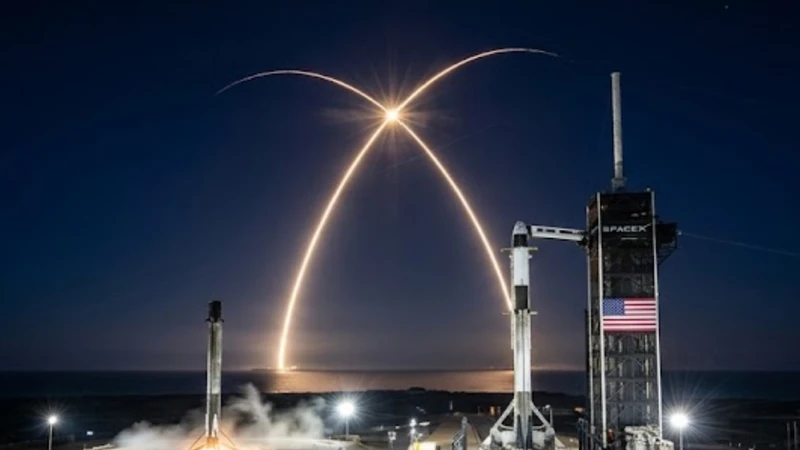
Before SpaceX, launching a satellite was like building a Boeing 747, flying it across the Atlantic once, and then crashing it into the ocean. By mastering the engineering required to land and reuse the first-stage boosters of the Falcon 9, SpaceX fundamentally altered the economics of space.
By eliminating the capital expenditure of building a brand-new rocket for every single mission, SpaceX drove down marginal launch costs to a fraction of the legacy industry standard. Because they launch their own Starlink satellites on their own reusable rockets, their internal cost of network deployment is unmatchable by any competitor. They have created a closed-loop system where their transport business subsidizes their infrastructure business, and vice versa.
The Financial Blueprint
SpaceX does not release audited public financials, but secondary market distributions and industry intelligence reveal a clear trajectory:
Metric Segment | The Legacy Model | The SpaceX Model |
Primary Revenue Driver | One-time government/commercial launch fees | Recurring enterprise & defense subscriptions (Starlink) |
Capital Expenditures | Disposable hardware built via cost-plus government contracts | Vertically integrated, mass-produced reusable hardware |
Competitive Moat | Political lobbying and regulatory capture | Absolute cost leadership and proprietary launch frequency |
The Real Risks
The valuation isn't a bubble built on hot air, but it is an aggressive bet on execution. Two main risks keep this from being a sure thing:
- Key-Man Risk & Operational Focus: The leadership team must maintain hyper-focus on commercial execution amid immense political, regulatory, and public scrutiny.
- Starship Execution: The next-generation Starship platform must achieve full, rapid reusability to unlock the next level of economics—mass-deploying larger "Gen 2" Starlink satellites and executing deep-space contracts for NASA profitably.
The Bottom Line
SpaceX isn't a speculative tech startup burning cash to acquire clicks. It is a infrastructure powerhouse that operates with the cost structure of a manufacturer and the recurring revenue potential of a software giant.
For investors looking at the macroeconomic landscape, SpaceX represents something rare: a private entity that has successfully weaponized capital efficiency to achieve an absolute, sovereign-grade market monopoly. It’s not a bubble; it’s a fortress.