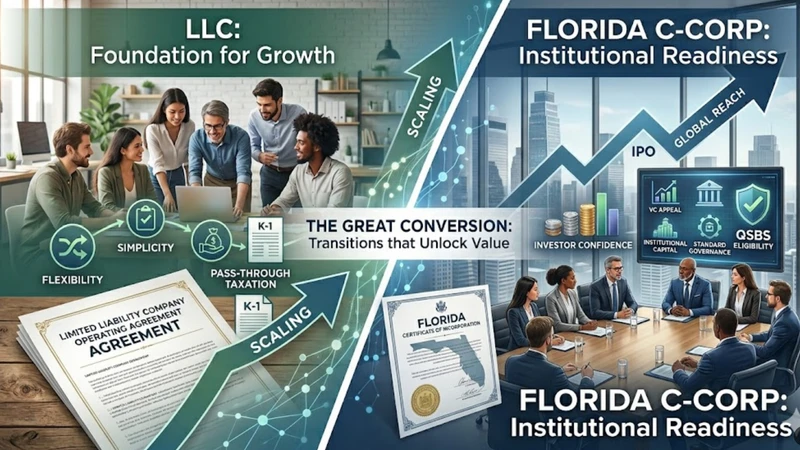
We get asked about converting from an LLC to a C-Corp all the time. Here is the short answer...
For most founders, the Limited Liability Company (LLC) is the ideal starting vehicle. It is simple, flexible, and allows business losses to flow through to personal tax returns—a nice silver lining during the lean early years. However, as you approach institutional venture capital or prepare for a major exit, the C-Corp becomes a non-negotiable requirement.
This transition, often called "The Flip," is a fundamental shift in how you own and grow your business. It is the move from a "lifestyle" or cash-flow structure to a "venture-scale" vehicle.
The Strategic Trade-Off: Pros and Cons
The shift to a C-Corp is a game of trade-offs. You are trading immediate tax flexibility for long-term scalability and investor appeal.
| Feature | LLC (Current) | C-Corp (Proposed) |
| Investor Appeal | Low (Strategic/Angels only) | High (Required for VCs) |
| Tax Treatment | Pass-through (K-1s) | Double-taxation (at Entity & Dividend levels) |
| The "Loss" Benefit | Losses shield personal income | Losses "trapped" at corporate level (NOLs) |
| Exit Incentive | None | Section 1202 (QSBS) - Potential tax-free gains |
| Equity | Profits Interests (Complex) | Standard Stock Options (ISOs/NSOs) |
Beyond Delaware: The New Jurisdictional Frontier
For decades, "Delaware C-Corp" was a single phrase. However, a shifting legal landscape has prompted CEOs to look at emerging, founder-friendly alternatives.
Florida: A rising powerhouse for tech and finance. With zero state personal income tax, Florida is incredibly attractive for founders when they eventually sell their shares. Its specialized business courts are increasingly sophisticated, mirroring Delaware’s speed.
Texas: With the 2024 launch of its specialized Business Court, Texas is explicitly challenging Delaware’s judicial dominance, particularly for firms rooted in the Austin and Dallas tech ecosystems.
Nevada: Known for the highest bar of privacy for directors and officers, and robust immunity from specific types of shareholder litigation.
The Shareholder Conversation: Managing the "K-1" Friction
The most difficult part of the flip is often convincing your early investors to give up their "tax write-offs." In an LLC, company losses flow to their personal returns; in a C-Corp, that benefit vanishes.
The Strategy: Pivot the narrative from annual write-offs to generational wealth.
The "Carrot": Lead with Section 1202 (QSBS). Explain that by flipping now, they start a 5-year clock toward potentially tax-free capital gains on their first $10M in profit.
The "Stick": Be direct about institutional capital. Venture funds are structurally prohibited from investing in pass-through entities. If the shareholders want the valuation to 10x, the structure must change.