When the retail crowd hears "manufacturing boom," they rush to buy the obvious names—Caterpillar or Boeing. But those trades are crowded, expensive, and highly vulnerable to macro headwinds.
The asymmetric bet right now isn't on the companies doing the manufacturing. It’s on the invisible layer making this chaotic technological transition possible.
Think about it: if every factory in America is scrambling to automate because they can't find workers, who wins? Not just the companies making the robots, but the engineering and software firms that integrate them.
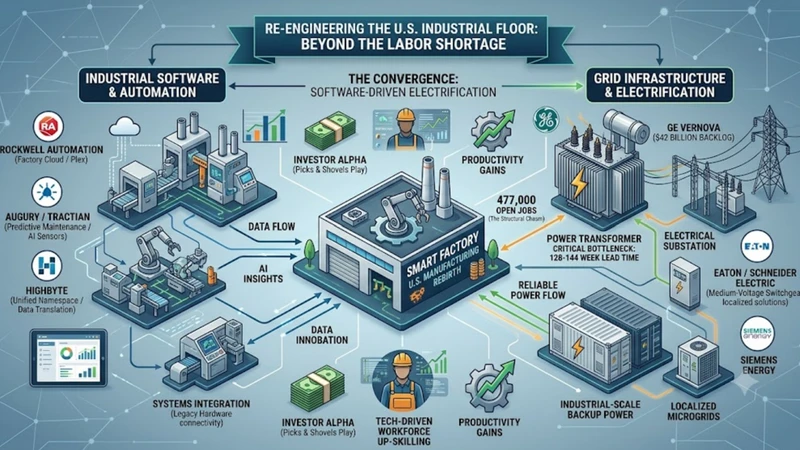
Putting a million-dollar robotic arm on a 30-year-old factory floor is an operational nightmare. It requires custom software to make legacy hardware talk to modern AI sensor platforms. This is where specialized systems integrators and industrial automation players like Rockwell Automation (and their factory-cloud platform, Plex) crush it. They are the pure-play beneficiaries of the labor shortage, capturing software-like margins while solving a multi-billion dollar physical problem.
Furthermore, this automation wave requires an unprecedented amount of juice. High-tech smart facilities—just like the data centers optimizing them—are putting an immense strain on the grid. The real, uncrowded alpha for 2026 lies in the unsexy grid infrastructure backing this play.
Right now, lead times for large power transformers have stretched to a staggering 128 to 144 weeks. Companies that control this bottleneck—like GE Vernova (which recently expanded its electrification backlog to a massive $42 billion) and Siemens Energy—are sitting on multi-year revenue runways that public markets are only beginning to price accurately.