Markets don’t vote. They discount the future — relentlessly, impersonally, and without cable news subscriptions.
Right now, investors are balancing three forces that rarely move in isolation: trade policy, earnings durability, and the cost of capital. Each one matters on its own. Together, they determine whether volatility is a passing tremor or something more structural.
Trade policy is back at center stage. Tariffs, reshoring, strategic competition — the language of economic nationalism is once again influencing boardrooms as much as campaign rallies. Markets can absolutely absorb a tougher trade posture. They can even thrive under it if the rules are clear and durable. What they cannot tolerate for long is ambiguity.
When policy appears tactical instead of strategic — subject to court rulings, executive pivots, or retaliatory escalation — investors widen spreads. Companies delay capital expenditures. CFOs model worst-case scenarios instead of expansion. It isn’t ideology that rattles markets. It’s unpredictability.
For Republican-leaning investors, this creates an interesting tension. The broader pro-growth framework — lower taxes, deregulation, capital formation — has historically been market-supportive. But broad tariffs layered on top of that framework introduce friction. Markets prefer capitalism with velocity. The more obstacles placed in the supply chain, the more investors demand compensation for risk.
That compensation shows up in valuations.
And yet, underneath the policy noise, earnings continue to do the heavy lifting.
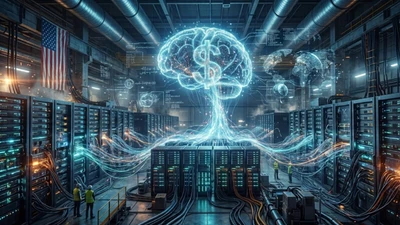
Technology remains the market’s profit engine, particularly companies powering AI infrastructure, advanced semiconductors, and cloud architecture. Margins, while not expanding dramatically, remain resilient. Cash flow generation is still strong. That matters more than any headline.
Politics can move multiples. Earnings compound wealth.
If profit growth continues, equities can digest moderate policy turbulence. If margins compress — whether from tariff costs, wage pressures, or higher borrowing expenses — the floor becomes less sturdy. The market’s tolerance for narrative quickly fades when spreadsheets deteriorate.
This is why the most serious investors are watching corporate guidance more closely than political commentary. Tax policy may influence after-tax profits. Regulatory posture may reduce compliance costs. But durable earnings power ultimately determines long-term returns.
Meanwhile, interest rates sit quietly in the background — the least theatrical but most consequential force of all.
Rates don’t argue. They enforce.
If inflation expectations drift upward — whether from fiscal expansion, trade friction, or supply constraints — bond yields will adjust first. Equities follow. Higher yields compress valuation multiples. Speculative growth loses altitude. Cash-generative companies regain appeal.
In a lower-rate world, optimism is cheap. In a higher-rate world, discipline is mandatory.
That distinction defines this cycle. We are no longer in an era where capital is free and narrative alone can command billion-dollar valuations. The cost of money now matters. And when money has a cost, business models must work.
Interestingly, while public markets wrestle with policy headlines, private capital has been moving quietly into strategic sectors aligned with long-term structural themes: domestic manufacturing automation, defense autonomy, AI infrastructure, energy independence.
Companies like Hadrian are building automated factories designed to restore advanced manufacturing capacity to the United States. Shield AI and Saronic are developing autonomous defense platforms in a world increasingly focused on national security. Fervo Energy is advancing next-generation geothermal systems that promise baseload domestic power. Lambda Labs and Cohere are expanding the infrastructure that allows enterprises to deploy AI at scale.
This is not speculative euphoria. It is capital reallocating toward resilience.
“Markets don’t care who makes the speech. They care who sets the rules — and whether those rules stick.”
If trade policy tightens, domestic production becomes more valuable. If geopolitical risk rises, autonomous defense systems attract funding. If labor costs remain elevated, AI-enabled productivity becomes essential. Policy uncertainty, paradoxically, creates clarity around certain structural bets.
For Republican-aligned investors, the opportunity lies not in reacting to rhetoric but in identifying where policy direction intersects with economic durability. Energy security. Industrial reshoring. Defense technology. AI-driven productivity. These are not partisan themes. They are strategic ones.
And they are investable.
None of this suggests markets are on the brink of collapse. Nor does it imply smooth sailing. It suggests something more familiar: a repricing of risk in a world where capital is no longer complacent.
Markets have compounded under both parties for decades because businesses innovate, generate cash, and expand into demand. Political cycles influence the path, but they rarely override economic gravity.
The real question isn’t who wins the argument.
It’s whether the rules become clear enough for capital to move confidently.