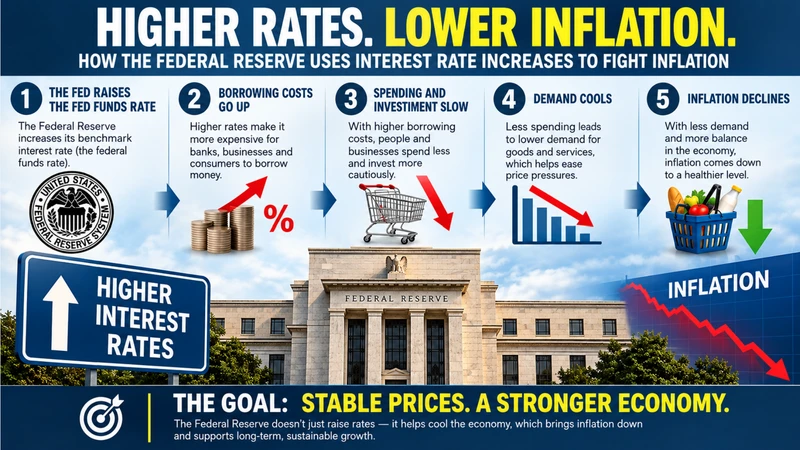
Yesterday, the Federal Reserve broke years of policy holding patterns and executed a quarter-point rate hike, establishing the new target range at 3.75%–4.00%.
For Wall Street, the move was a sharp bucket of cold water. Equity indices immediately repriced, bond yields spiked, and market commentary exploded with theories about the next six months. But for the rest of the economy, yesterday’s decision isn't a instantaneous shift—it's the first ripple in a long, delayed wave.
Here is what yesterday’s quarter-point rate hike actually changes right now, what it leaves completely untouched, and how quickly the real-world fallout will occur.
What Changes Immediately: Wall Street’s Real-Time Repricing
Financial markets operate on discounted cash flows and forward-looking algorithms. Because of this, yesterday’s announcement triggered immediate asset repricing across three distinct vectors:
Equity Valuations Under Pressure: Higher baseline borrowing costs increase the discount rate on future cash flows. Tech, high-growth, and debt-heavy balance sheets faced immediate selling pressure as valuations were recalibrated downward.
Short-Term Yield Jump: The 2-Year Treasury yield immediately moved higher to reflect the shift, pulling up short-term borrowing costs across capital markets.
Dollar Strength Surge: Higher domestic interest rates instantly drove foreign capital into US Dollar-denominated yields, strengthening the currency in foreign exchange trading within hours of the announcement.
What Yesterday's Decision Changes Very Slowly (or Not at All)
Despite the dramatic market headlines, the Fed's rate hike does not instantly reorder the real economy. Understanding where the friction lies prevents unnecessary panic:
Fixed-Rate Borrowers Are Unaffected
Over 85% of American homeowners hold 30-year fixed-rate mortgages locked in at lower historical levels. Yesterday's rate hike adds zero dollars to their monthly payments. Unless a homeowner is actively applying for a new mortgage or refinancing, the Fed’s decision has no immediate operational impact on their household debt.
Variable Debt Reprices Within 30 to 60 Days
While fixed debt stays constant, variable credit products tied to the Prime Rate—such as credit cards and Home Equity Lines of Credit (HELOCs)—will reflect yesterday's quarter-point addition within one to two billing cycles.
Supply Chains and Structural Costs
The Fed raised rates yesterday to cool aggregate demand, but monetary policy cannot manufacture cheap energy, build more homes, or clear shipping bottlenecks. Structural supply issues remain immune to rate adjustments.
The Transmission Lag: When Does Main Street Actually Feel It?
The biggest gap in financial coverage is confusing news reaction with economic transmission. The full impact of yesterday's decision will unfold over four distinct phases:
| Phase | Timeline | Operational & Market Reality |
| Phase 1: Financial Asset Repricing | 0 to 48 Hours | Equities, bond yields, and forex rates adjust instantly to the new benchmark rate and Fed guidance. |
| Phase 2: Banking Adjustments | 30 to 60 Days | Banks pass the 25 bps increase onto variable-rate credit cards, HELOCs, and new loan origination terms. |
| Phase 3: Corporate Realignment | 6 to 12 Months | Companies update capital allocation models, re-evaluate corporate borrowing costs, and adjust CapEx budgets. |
| Phase 4: Macro Economy Shifts | 12 to 24 Months | The cumulative effect of higher borrowing costs fully reflects in employment data, consumer spending, and core CPI. |