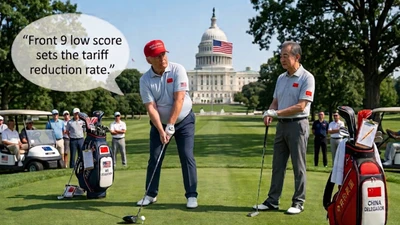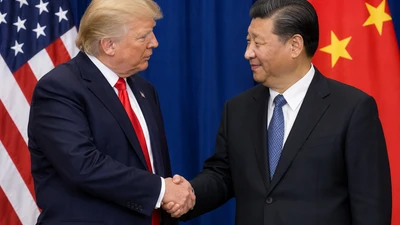
There is always a lot of noise surrounding a meeting between the presidents of the United States and China. Headlines talk about breakthroughs, historic agreements and the possibility of a new relationship. Investors, however, should probably be paying attention to something much simpler: what actually changes for American businesses after the meeting?
That is where the Trump-Xi meeting gets interesting.
The United States and China have agreed to extend their current trade truce from November 10 to January 10, giving negotiators additional time to work through the much larger issues between the two countries. That may not sound like a blockbuster announcement, but for businesses trying to plan inventory, manufacturing, capital expenditures and supply chains, another two months of tariff certainty can be worth a lot.
I don't think investors should interpret this as the end of the U.S.-China economic battle. It looks more like the two countries are figuring out how to compete without constantly pulling the economic emergency brake.
And that could actually be better for investors.
For years, American companies have been trying to answer a difficult question: How much of our supply chain can we safely leave in China?
The answer has increasingly been "less than before."
But moving a supply chain isn't like moving a house. It takes years, billions of dollars and a lot of headaches. Companies have to find suppliers, build factories, qualify components, hire people and develop new logistics networks.
That is why the most interesting investment opportunity from this meeting may not be China at all.
It may be the companies helping America become less dependent on China while still doing business with China.
That is a subtle but important distinction.
Think about robotics, automation, industrial software, domestic manufacturing, logistics, advanced materials, cybersecurity and critical minerals. These businesses can potentially benefit whether relations between Washington and Beijing improve or deteriorate.
That's the kind of investment thesis I like because it doesn't require you to correctly predict the next presidential handshake.
Rare earths are the real story
One of the most important issues coming out of the negotiations is something most Americans probably never think about: rare earth elements.
They are critical to electric motors, electronics, aerospace, defense systems and many other high-tech products. China has built an enormous advantage in mining and, more importantly, processing these materials.
The United States is trying to change that.
U.S. rare-earth production has increased dramatically, but domestic production still doesn't satisfy the country's entire demand. Even with additional production coming online, the United States is expected to remain dependent on imports for years.
That creates a fascinating investment opportunity.
It isn't just about finding a mine.
The bigger opportunity could be in the businesses that sit between the mine and the finished product—processing, refining, recycling, magnet manufacturing and the technology that makes those processes cheaper.
This is exactly the kind of industry transformation that can produce interesting early-stage companies.
And there is another reason I like watching this space.
If China cooperates and rare-earth supplies become more reliable, American manufacturers benefit.
If China doesn't cooperate, the United States has even more incentive to invest in domestic alternatives.
Either way, somebody has to build the alternative supply chain.
The trade agreement is also more interesting than it looks
The countries are working through a new trade mechanism that could eventually reduce tariffs on selected categories of goods. The discussions reportedly include U.S. agriculture, energy and medical devices, along with certain Chinese consumer and lower-tech manufactured goods.
That tells us something.
There are areas where the two countries can still do business quite profitably.
Nobody has suggested that every Chinese product should disappear from the American market or that every American product should disappear from China.
That's simply not how global commerce works.
The more realistic outcome is a world where the United States becomes much more selective about what it is willing to depend upon China for.
That could actually be good for American entrepreneurs.
A company doesn't have to replace China.
It may only have to replace one small but important part of the Chinese supply chain.
That's a much smaller problem—and potentially a very profitable business.
Watch what China actually buys
One of the things I find particularly interesting about these negotiations is the difference between agreements and transactions.
China can agree to buy American agricultural products.
The real question is whether the purchase orders show up.
China can agree to make rare-earth materials available.
The real question is whether the shipments arrive.
China can agree to purchase aircraft.
The real question is whether the orders turn into deliveries.
That's where investors should focus.
Agriculture could benefit if Chinese purchases of American products increase. Boeing and its enormous network of American suppliers could benefit if aircraft orders materialize. Transportation, logistics and commodity businesses could also see second-order effects. The White House has previously cited Chinese commitments involving U.S. agricultural purchases and Boeing aircraft.
In other words, don't invest in the headline.
Invest in the economic activity that follows the headline.
Then there's AI
If you think tariffs and rare earths are important, don't overlook artificial intelligence.
AI may ultimately be the most important economic competition between the two countries.
The United States and China are both pouring enormous resources into AI, semiconductors and computing infrastructure. At the same time, the United States continues to restrict China's access to some advanced semiconductor technologies.
That means we could end up with something unusual: two enormous AI ecosystems developing simultaneously, but with increasing separation between them.
For investors, that means opportunities aren't necessarily limited to the companies writing the AI models.
Someone has to provide the chips.
Someone has to build the data centers.
Someone has to provide electricity.
Someone has to cool the machines.
Someone has to connect them.
Someone has to secure them.
And someone has to develop the industrial software that puts AI to work.
Sometimes the best investment in a gold rush isn't the guy selling gold.
It's the guy selling the picks and shovels.
What does all of this mean for the stock market?
Probably less than some of the headlines suggest in the immediate term.
The trade truce reduces one source of uncertainty, and that can help companies with China exposure. But the major issues—technology, semiconductors, Taiwan, critical minerals and national security—haven't disappeared.
I wouldn't look at the Trump-Xi meeting and conclude that China is suddenly "back" as an investment opportunity.
I'd look at it differently.
The world is restructuring its supply chains.
And whenever supply chains are restructured, money gets spent.
Factories have to be built. Equipment has to be purchased. Software has to be installed. Workers have to be trained. New suppliers have to be found. Transportation networks have to change.
That's a lot of economic activity.
For investors interested in early-stage companies, this may be even more interesting than the public markets.
Imagine a startup that can reduce the cost of reshoring a manufacturing operation by 20%.
Or one that helps a manufacturer identify exactly where it is dependent on Chinese suppliers.
Or one that recovers rare earth materials from industrial waste.
Or one that uses robotics to make a domestic factory competitive with a lower-cost Asian manufacturer.
Those aren't necessarily "China plays."
They're China-transition plays.
And I think that distinction is worth remembering.
The inside information investors should really watch
There is one piece of this story that isn't getting nearly as much attention as tariffs and trade headlines: investment itself.
The United States and China have been discussing mechanisms to facilitate investment between the two countries, but national-security restrictions mean the rules are likely to be very different depending on what is being invested in.
Money going into a sensitive semiconductor company is obviously going to get a very different reception from money going into an ordinary manufacturing operation.
If those investment channels become clearer, however, it could eventually create another source of capital for U.S. businesses.
For private investors, that's worth watching.
The bigger question isn't whether Chinese money will suddenly pour into American startups. It probably won't happen in sensitive industries.
The interesting question is whether the two governments eventually establish predictable rules that allow capital to move into commercially useful but strategically less sensitive businesses.
That could open some doors that have been effectively closed for years.
My takeaway
I don't think the Trump-Xi meeting represents the end of the economic competition between America and China.
Quite the opposite.
It may represent the beginning of a more organized version of that competition.
The countries still need each other economically, but both are increasingly determined to control the parts of their economies that they consider strategically important.
For investors, that creates an unusual situation.
We don't have to predict whether America and China become friends.
We don't have to predict whether the next tariff goes up or down.
We can look for companies that make money because businesses need to adapt to either outcome.
That's where I think some of the most interesting opportunities are going to develop.
The next great American manufacturing story may not be about beating China. It may be about making America competitive enough that China no longer has to be the default answer.
And for an early-stage investor, finding the companies that make that possible could be a lot more interesting than trying to guess what the next presidential meeting will produce.