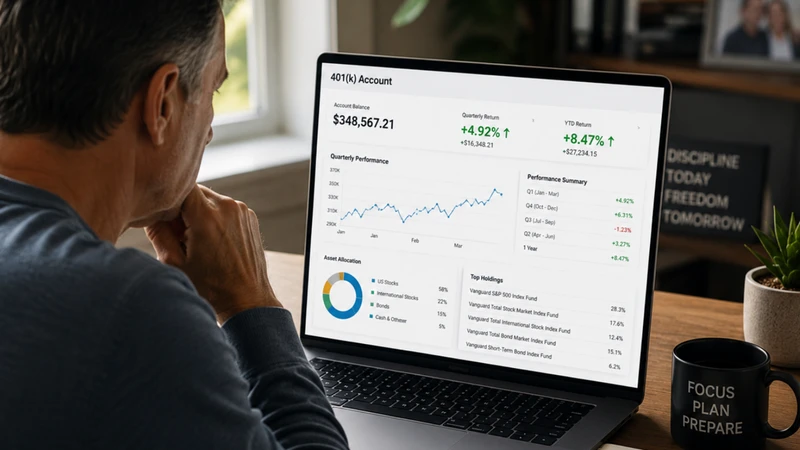
If you have a 401(k), you’re not just “saving for retirement.” You’re sitting inside one of the most sensitive pressure gauges of the entire financial system.
And right now, that gauge is flashing mixed signals.
The markets aren’t collapsing. They’re not booming in a clean, broad-based way either. What we’re seeing is something more uncomfortable: concentration, policy uncertainty, and a shift in where returns are actually coming from.
That matters — because most 401(k)s are still built like it’s 2015.
Here’s what’s actually going on.
1. The Market Is Being Driven by Fewer and Fewer Winners
A big portion of index performance is still being driven by a small group of mega-cap companies. In simple terms: your 401(k) may look diversified, but the engine under the hood is not.
When a handful of names dominate returns, two things happen:
- Your account can rise even if most stocks are flat or down
- Your “diversification” quietly becomes concentration risk
This isn’t necessarily a bubble, but it is a structural imbalance. And if leadership rotates — even slightly — many portfolios will feel that shift faster than they expect.
2. Interest Rates Are Still Repricing Everything
Even if rates have stopped grabbing headlines every day, they’re still the most important force in your 401(k).
Higher-for-longer borrowing costs have reshaped:
- Stock valuations (especially growth stocks)
- Corporate refinancing cycles
- Bond yields (finally giving income investors real alternatives)
- Real estate and private credit markets
The key shift: cash and short-term bonds are no longer “dead money.” For the first time in years, you’re getting paid to be conservative.
That changes behavior across the entire retirement system.
3. Bonds Are Back — But Most People Haven’t Adjusted
A lot of 401(k) allocations are still psychologically stuck in the zero-rate era.
But today’s bond environment is different:
- Yields are meaningful again
- Duration risk actually matters again
- Fixed income is once again a real portfolio stabilizer
The problem is behavioral, not structural. Many investors still treat bonds as “optional ballast,” when in reality they’re now a core return component again.
4. Passive Investing Is Quietly Amplifying Volatility
Index funds didn’t break the market — but they did change how it moves.
As more capital flows into passive strategies:
- Winners keep getting more inflows automatically
- Losers can disconnect from fundamentals longer than expected
- Market moves become more “mechanical” during stress events
This is especially relevant for 401(k)s, because most contributions are automatically allocated into passive structures.
That creates a system where flows — not just fundamentals — drive short-term price action.
5. The Real Risk Isn’t a Crash — It’s Complacency
Most people think the risk to their 401(k) is “the next recession.”
In reality, the bigger risk is quieter:
- Not rebalancing during regime shifts
- Assuming past decade performance will repeat
- Staying overexposed to the same drivers of return
Retirement portfolios don’t usually fail because of one bad year. They underperform because they drift out of alignment for years at a time.
What This Means for Investors
You don’t need to overhaul your 401(k) every time headlines shift.
But you do need to recognize this:
We are not in a “set it and forget it” environment anymore.
Rates, concentration, and liquidity conditions are actively reshaping how returns are generated. That means the default portfolio may not be doing what you think it’s doing.
The goal isn’t to predict the next move.
The goal is to stop assuming the last cycle still applies.