One of the largest industrial investments in modern American history is headed to Iowa.
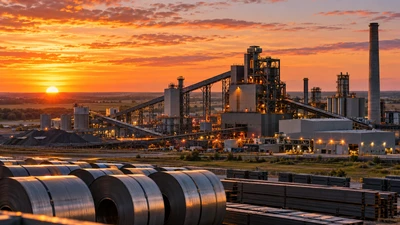
Mesabi Metallics, backed by India’s Essar Group, has announced plans for a $15 billion steel complex in Lee County, Iowa, as part of an approximately $18 billion investment connecting the plant with the company’s iron ore operations in Minnesota. The Iowa facility is expected to begin producing steel around 2030.
And this is much bigger than a new factory opening in the Midwest.
If the project is completed as planned, it could alter where American steel is produced, how that steel is made, and how much of the supply chain can be kept inside the United States.
From the Mine to the Mill
The most important part of the project may actually be what happens before the steel reaches Iowa.
Mesabi Metallics is developing its iron ore operation on Minnesota’s Mesabi Iron Range. The company plans to ship that material by rail to Iowa, where it can be converted into finished steel.
That creates something the American industrial economy has increasingly been trying to rebuild: a more integrated domestic supply chain.
Instead of depending on separate overseas suppliers for different stages of production, Mesabi's strategy connects American iron ore, American transportation infrastructure and American steelmaking.
The U.S. Export-Import Bank recently approved a $770 million direct loan supporting Mesabi's Minnesota operation. EXIM says the facility is expected to produce as much as seven million tons annually of high-grade direct-reduction-grade iron ore pellets — material used by modern steelmaking facilities.
That matters because nearly all iron ore ultimately feeds the steel industry. According to the U.S. Geological Survey, about 98% of iron ore is used for steelmaking.
The Scale Is Enormous
Mesabi says the Iowa complex will initially be capable of producing approximately 7.5 million tons of steel annually, with capacity eventually reaching roughly 10 million tons per year.
To put that into perspective, the American Iron and Steel Institute reported that total U.S. raw steel production was about 90 million net tons in 2025.
A single new operation eventually capable of producing around 10 million tons therefore represents significant potential capacity entering the American market.
The project is also expected to support roughly 1,750 permanent jobs in Iowa and thousands of construction jobs during development.
But the economic impact could spread far beyond the workers employed inside the plant.
A facility of this size needs railroads, electricity, mining equipment, construction materials, industrial machinery, maintenance contractors, scrap metal, logistics providers and dozens of other supporting industries.
That is where the story begins to extend beyond steel companies themselves.
American Steelmaking Is Changing
For decades, many people pictured steel production as enormous blast furnaces burning coal and processing iron ore.
Modern American steelmaking increasingly looks different.
Electric arc furnaces, or EAFs, melt steel primarily using electricity and scrap metal, although modern operations can combine scrap with higher-quality iron inputs such as direct-reduced iron.
The technology can be more flexible and considerably less energy intensive than traditional blast-furnace steelmaking. The Energy Information Administration has previously identified the shift toward electric arc furnaces as an important reason energy intensity in U.S. steel production has declined.
That shift has major implications.
Future competition in steel may increasingly revolve around access to inexpensive electricity, quality scrap, high-grade iron ore, transportation networks and highly efficient modern mills.
The Iowa project touches nearly every one of those themes.
More Steel Is Good for Manufacturing — But Competition Will Get Tougher
There is another side to the announcement.
A massive increase in steel capacity does not automatically mean every existing steel producer benefits.
Steel remains a commodity business. When too much capacity enters the market relative to demand, prices can fall and producer margins can get squeezed.
Investors noticed that risk almost immediately after the announcement. Shares of several large American steel producers declined as markets considered what millions of additional tons of future production could mean for steel prices and competition.
The facility is not expected to begin production until around 2030, so this is not an immediate supply shock.
But it sends a message.
Companies operating older, higher-cost facilities may face increasing pressure from newer plants designed around more efficient technology and integrated supply chains.
That could gradually separate the industry into winners and losers.
The Bigger Investment Story
For investors, the Iowa announcement may therefore be less about finding one company that benefits and more about recognizing a broader industrial cycle.
A major expansion of American steelmaking creates potential demand across the entire steel ecosystem:
Iron ore and high-grade metallic feedstocks.
Scrap collection and recycling.
Electric arc furnace technology.
Industrial electricity infrastructure.
Rail transportation.
Steel processing and fabrication.
Specialty steels used in automobiles, energy infrastructure, defense and advanced manufacturing.
Construction and industrial equipment.
The companies supplying those industries may sometimes have different economics than the companies actually selling commodity steel.
And that distinction matters.
Steel prices will rise and fall. Construction cycles will come and go. New capacity could pressure margins.
But rebuilding industrial capacity requires enormous amounts of equipment, energy, transportation and raw materials regardless of which steel producer ultimately captures the greatest market share.
That may ultimately be the most important lesson from Iowa.
The new mill is not simply another steel plant.
It is evidence that billions of dollars are once again being committed to building large-scale American industrial infrastructure.
And when investments of that magnitude begin moving through an economy, the opportunity rarely stops at the factory gates.