
In the world of capital allocation, investors spend endless hours hunting for asymmetric returns. We evaluate market multiples, private equity deal flow, alternative credit yield, and real estate cap rates—all in search of an edge that can withstand inflation, market volatility, and economic downturns.
Yet, the most high-yielding, downside-protected asset in any portfolio isn't a stock, a property, or a fund.
It is you.
Investing in yourself is often dismissed as a self-help platitude. In reality, it is a disciplined financial and strategic framework. When executed properly, human capital investment generates exponential compound returns, opens proprietary deal flow, and creates an intellectual moat that no market collapse can wipe out.
What It Actually Means to Invest in Yourself
Investing in yourself does not mean buying a motivational book or attending an expensive conference for the networking high.
In pure capital terms, investing in yourself means allocating time, money, and focus toward expanding your earning capacity, decision-making quality, and long-term leverage.
Think of yourself as an operating business:
Your Core Skill Set is your primary product.
Your Professional Network is your distribution channel.
Your Health & Mindset is your infrastructure.
Your Reputation & Intellectual Capital is your brand equity.
When you invest capital back into this operating enterprise, you improve your baseline yield. A 10% return on a $100,000 equity portfolio yields $10,000. But a strategic $5,000 investment in a core competency that increases your annual income or deal capability by $50,000 yields a 1,000% return in year one alone—compounding every year thereafter.
The Four Pillars of Human Capital Allocation
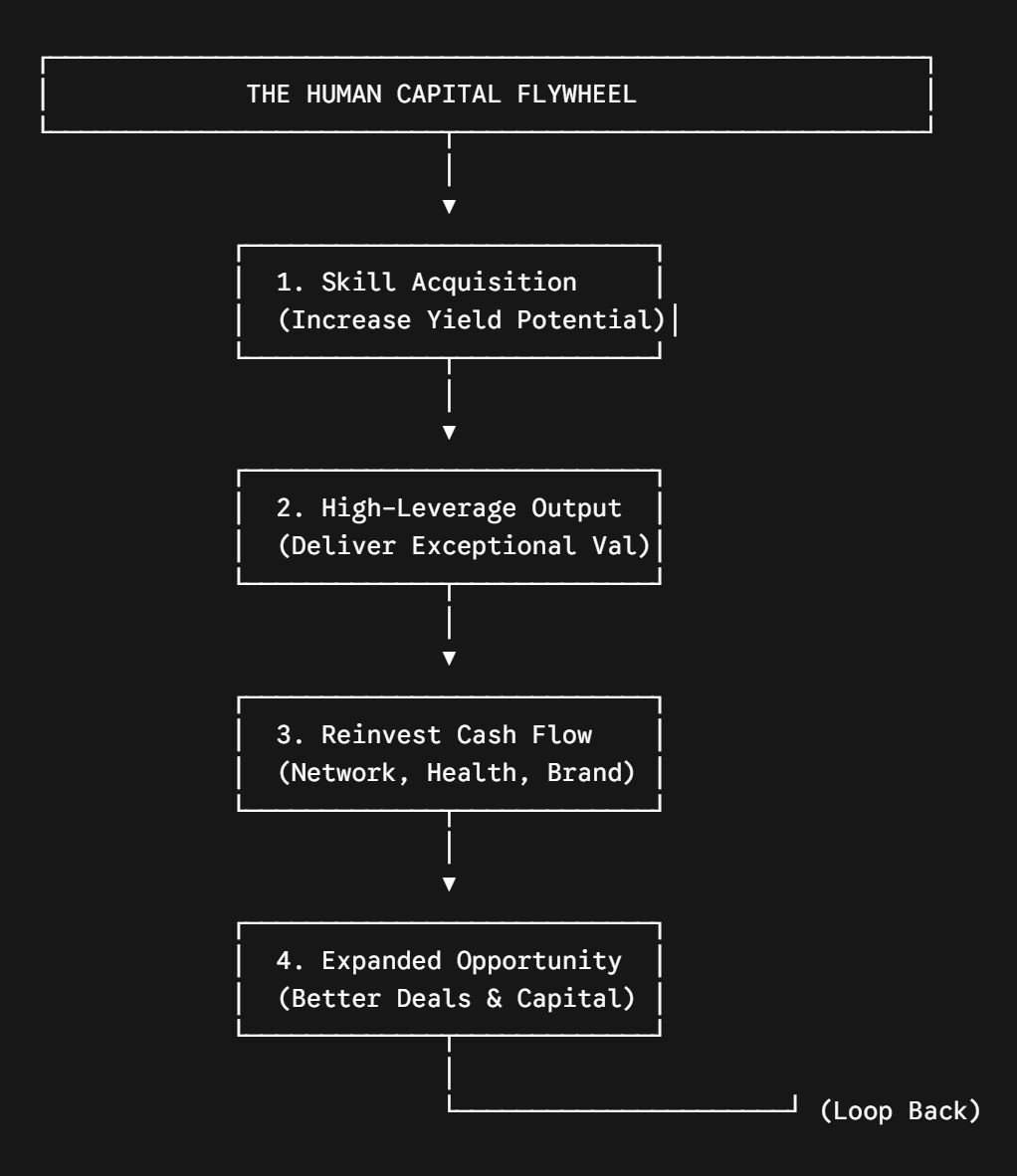
To build a structured approach toward self-investment, divide your allocation across four core verticals:
1. Acquiring High-Leverage Skills
The market pays for rarity and value creation. Investing in skill acquisition means moving beyond foundational knowledge into high-leverage domains:
Technical Mastery & Industry Expertise: Deepening specialized knowledge in corporate governance, capital raising, complex deal structuring, or emergent technologies.
Communication & Persuasion: Mastering the art of executive communication, investor pitch formulation, and board-level negotiation.
Capital Allocation & Financial Literacy: Understanding balance sheets, risk-adjusted returns, and unit economics—regardless of your industry.
2. Expanding Your Intellectual & Relationship Capital
Your network is not just a list of contacts; it is your proprietary intelligence network.
Curate Your Inner Circle: Proactively seek out peers, advisors, and mentors who operate at a higher level than you do.
Join High-Value Cohorts: Executive coaching programs, advisory boards, and selective industry groups provide peer accountability and deal flow you cannot access publicly.
Build Public Proof: Publish insights, share market commentary, and document your frameworks. Thought leadership lowers the friction of trust.
3. Preserving the Infrastructure (Health & Energy)
An asset cannot perform if the machine breaks down. Physical and mental longevity are directly correlated with decision quality.
Optimize Bio-Metrics & Energy: Prioritize sleep hygiene, executive physicals, structured fitness, and nutrition. High energy is a competitive advantage in long negotiations.
Protect Mental Bandwidth: Eliminate low-value operational noise. Delegate tactical tasks to focus strictly on strategic, high-value decisions.
4. Investing in Your Personal Brand & Positioning
In a crowded marketplace, positioning determines pricing power.
Clarify Your Value Proposition: Define precisely what problem you solve and for whom.
Refine Your Executive Presence: From your digital footprint to how you present in the boardroom, credibility accelerates deal execution.
How to Execute: A Practical Framework
Investing in yourself requires the same rigor as underwriting a private equity investment or commercial venture.
Audit Your Current Yield: Identify where your skill set or network is currently bottlenecking your growth. Is it deal structuring? Public presentation? Leadership capacity?
Set a Dedicated Self-Investment Budget: Allocate a non-negotiable percentage of your annual income (e.g., 5% to 10%) specifically for coaching, education, health optimization, and high-level networking.
Measure Return on Experience (ROE): Evaluate every self-investment against concrete outcomes: Did this expand my deal flow? Did this improve my leadership decision-making? Did this save me five years of trial-and-error?
The Bottom Line
Markets fluctuate, tax laws shift, and economic cycles turn. But the knowledge, judgment, networks, and reputation you build stay with you permanently.
When you invest in yourself, you are making the ultimate asymmetric bet: capped downside, virtually infinite upside, and a yield that compounds for the rest of your life.