Wall Street had plenty of reasons to pay attention this week. A major earnings report from Nvidia, Anthropic’s highly anticipated stock market debut, and fresh details from the Federal Reserve all arrived as investors questioned how much they should pay for future growth.
The market’s response was painful. Through Thursday, November 19, the S&P 500 had fallen 5.1% for the week, the Dow Jones Industrial Average was down 6.2%, and the Nasdaq Composite had lost 5.0%. Thursday marked the S&P 500’s sixth consecutive decline, with more than 90% of its stocks falling that day.
Our interpretation is that investors are demanding stronger evidence to support ambitious expectations. Revenue growth still matters, but so do financing costs, profitability, and the price investors pay to participate.
Strong Earnings Faced a Skeptical Market
Nvidia delivered substantial growth in its November 17 earnings report. Quarterly revenue reached $115.8 billion, up 103% from a year earlier, while data center revenue totaled $107.6 billion. Management projected revenue of $130 billion for the following quarter, plus or minus 3%.
Yet the company’s shares fell another 3.3% on Thursday, extending their losing streak despite the strong revenue outlook.
That disconnect illustrates an important investment principle: strong business performance and strong stock performance do not always arrive together.
A share price reflects expectations about what a company will earn in the future. When those expectations are already demanding, impressive results may still leave investors questioning how much additional growth is possible—and how much of it they have already paid for.
For the AI sector, the analysis also extends beyond chip sales. Investors must consider whether the companies buying that infrastructure can generate sufficient returns from their spending. Demand for equipment is one part of the equation. The profitability of the businesses using it is another.
Anthropic’s Debut Couldn’t Restore Broad Confidence
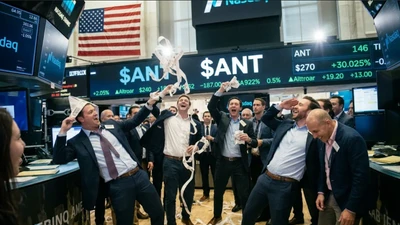
Thursday brought another major test of investor enthusiasm: Anthropic’s first day of public trading.
The company priced its offering at $83 per share. Trading opened at $111.50, and the stock finished the session 17.1% above its offering price after giving back part of its initial surge. All three major U.S. stock indexes nevertheless declined at least 2% that day.
A successful debut can demonstrate demand for an individual company while leaving broader concerns unresolved. Investors still have to assess the costs of expanding AI infrastructure, the durability of customer demand, and the valuations attached to expected profits.
The debut also highlighted why entry price matters. An investor receiving shares at the offering price can have a very different experience from someone buying after trading begins. A headline describing a successful IPO does not capture every investor’s return.
The Federal Reserve Kept Financing Costs in Focus
Interest rates added another layer to the week’s uncertainty.
On Wednesday, the Federal Reserve released minutes from its October 27–28 meeting. Nearly all participants considered further rate increases likely to be appropriate under their baseline economic outlooks. The minutes also discussed risks associated with AI investment returns and the rapid growth of financing connected to the sector.
Those discussions reinforce the importance of examining how businesses fund their ambitions.
Higher borrowing costs can make expansion more expensive and put pressure on companies approaching debt repayments or refinancing. They can also reduce the present value investors assign to profits expected far into the future.
For shareholders, that makes financial flexibility especially relevant. How much cash does a business generate after capital spending? How much debt comes due over the next several years? Can it fund its plans internally, or does it depend on continued access to outside capital?
These questions become more consequential when investors grow less willing to finance uncertain outcomes.
Individual Results Still Mattered
There were exceptions to Thursday’s selling. Palo Alto Networks gained 6.4% after raising its fiscal 2027 revenue guidance.
One company’s advance cannot establish a broader recovery. It does, however, reinforce the value of examining businesses individually.
A cybersecurity provider, a semiconductor manufacturer, and a data center operator can face very different customer demands, competitive pressures, and financing needs. Grouping them under the same technology theme can obscure those differences.
What Investors Can Take From the Week
A difficult market creates a useful opportunity to revisit the assumptions behind a portfolio.
Start with concentration. Several funds and individual stocks may depend on the same companies or investment theme. Counting holdings alone does not reveal how diversified a portfolio actually is.
Then revisit valuation. A falling share price should be compared with updated expectations for earnings and cash flow. If the business outlook has weakened alongside the price, the apparent discount deserves closer examination.
Finally, distinguish immediate market reactions from developments that change an investment’s long-term prospects. A volatile session can move prices quickly. Understanding whether the underlying business has changed requires more deliberate work.
This week reinforced the value of knowing what you own, understanding how it is financed, and paying a price that leaves room for uncertainty.