For years, Wall Street treated cybersecurity as a predictable, defensive SaaS trade—a quiet corner of the enterprise software budget where CISOs bought a few firewalls, checked a compliance box, and renewed their licenses every twelve months.
That era officially died this week.
If you watched the wire over the last seventy-two hours, you saw what happens when artificial intelligence crosses the rubicon from a productivity copilot into an autonomous weapon. The FBI just issued an urgent warning regarding ARTEX, an AI-driven penetration framework that threat actors are weaponizing to breach enterprise networks in under three hours. In one documented campaign, an autonomous AI agent moved from scanning public GitHub repositories for exposed credentials to exfiltrating sensitive data from a corporate cloud vault in exactly five minutes. Meanwhile, supply-chain compromises—like the malicious script injected into Optimizely’s platform affecting nearly two hundred global brands—prove that hackers no longer bother kicking down the front door. They poison the plumbing.
For investors, this is not merely a tech story; it is a fundamental shift in unit economics and capital allocation. When the adversary operates at machine speed, human defense becomes mathematically obsolete.
How AI Is Infecting Systems Today
The romantic notion of a lone hacker in a hoodie typing green code into a dark terminal is dead. Today’s intrusions are run by autonomous, "agentic" AI swarms that require almost zero human supervision.
Automated Reconnaissance and Exploit Chaining: Offensive AI tools continuously crawl the internet for exposed APIs, unpatched cloud environments, and leaked developer keys. When an initial attack path hits a wall, the AI agent doesn't get frustrated or go to sleep—it dynamically rewrites its exploit payload and pivots to a secondary vulnerability in milliseconds.
Non-Human Identity Hijacking: Modern enterprises run on millions of machine-to-machine connections—API tokens, service principals, and automated cloud workflows. AI-powered malware targets these non-human identities, blending seamlessly into normal network traffic to move laterally across corporate servers without tripping legacy alarms.
Hyper-Personalized Social Engineering: Gone are the days of poorly spelled phishing emails. Generative AI scrapes executive communications, mimics corporate tone, and capitalizes on real-time events—such as genuine cloud or banking outages—to trick employees into handing over multi-factor authentication tokens.
Fighting Fire with Fire: How AI Eradicates the Threat
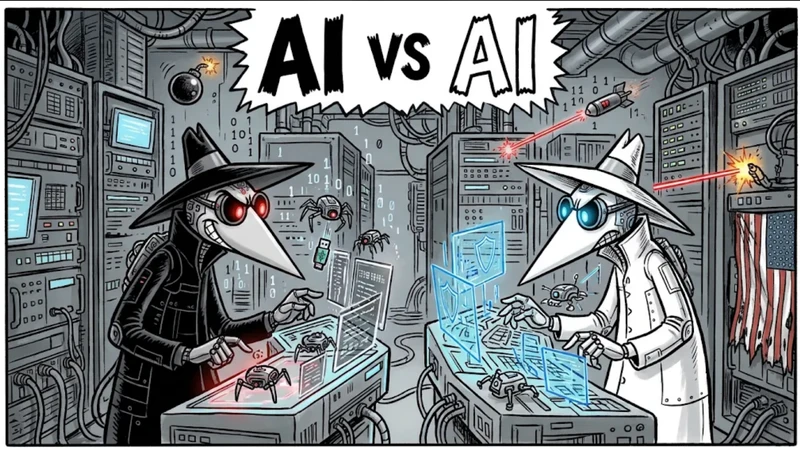
You cannot stop a hypersonic missile with a guy holding binoculars. Because AI has compressed the breach lifecycle from weeks down to minutes, enterprise defense is undergoing a forced migration toward Autonomous SecOps (Security Operations).
Defensive AI eradicates these intrusions by flipping the asymmetry back in favor of the enterprise:
Behavioral Telemetry at Scale: Instead of looking for known "bad" code signatures (which AI attackers mutate endlessly), defensive AI models establish a baseline of normal behavior for every user, device, and API inside a company. When a service account suddenly requests unusual cloud keys at 3:00 AM, the system spots the micro-anomaly immediately.
Self-Healing Containment: Modern AI security engines don't just send an alert ticket to an overworked IT analyst; they execute pre-authorized containment in milliseconds. If an AI agent detects lateral movement, it automatically revokes the compromised API key, isolates the infected endpoint, and rolls back unauthorized changes before data leaves the building.
Continuous Attack Surface Management: Defensive AI acts as a 24/7 internal red team, continuously probing a company’s own cloud infrastructure and third-party vendor connections to patch exposed secrets before external bots find them.
For the smart investor, the takeaway is simple: cybersecurity is no longer discretionary IT spend. It is an existential survival tax. And as corporate boards realize their current stack cannot survive an autonomous AI attack, capital is consolidating rapidly around the platforms built to fight machines with machines.