For most people, the stretch between Thanksgiving and New Year’s is defined by travel delays, family dinners, and hunting for last-minute gifts. For Wall Street, however, the holiday season is a distinct financial ecosystem—one driven by massive consumer spending surges, calendar-induced liquidity shifts, and aggressive year-end portfolio housekeeping.
While holiday folklore often paints December as an effortless sleigh ride higher, seasoned market participants know that seasonal tailwinds come with plenty of nuance. Understanding how the calendar shapes market behavior can help investors separate holiday cheer from actionable strategy.
What the Holidays Mean for the Stock Market
Historically, the fourth quarter—and December in particular—is one of the strongest stretches of the year for U.S. equities. Since 1950, December has ranked among the top-performing months for the S&P 500, driven by a combination of institutional positioning, year-end bonus inflows, and holiday optimism.
At the center of this seasonal narrative is the famous "Santa Claus Rally"—a specific seven-trading-day window encompassing the last five trading days of December and the first two trading days of January. Going back to 1950, the S&P 500 has finished higher during this narrow window roughly 76% of the time, posting an average gain of about 1.25% to 1.3%.
However, the calendar doesn't move in a straight line:
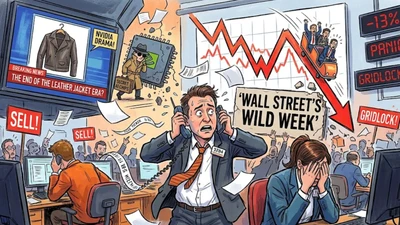
The Early-December Dip: Before the late-month festivities begin, early-to-mid December frequently experiences choppy trading. Institutional mutual funds distribute capital gains, corporate share-buyback windows temporarily close ahead of Q4 earnings, and final central bank policy meetings inject rate uncertainty.
Holiday Liquidity Quirks: Trading desks thin out considerably around Thanksgiving, Christmas Eve (when U.S. markets close early at 1:00 p.m. ET), and New Year’s. Lower trading volume means fewer buyers and sellers are active, which can exaggerate price swings on unexpected headlines.
Folklore Isn't a Guarantee: While a strong year-end finish is the historical norm, recent years have shown that macro forces—like interest rate trajectories and inflation—can easily override seasonal tendencies.
Where the Opportunities Are
When consumer wallets open up, capital naturally rotates toward the sectors that capture, move, and finance those dollars.
Bifurcated Retail (Value vs. Luxury): Holiday retail spending in the U.S. has crossed the $1 trillion milestone, yet consumer behavior increasingly resembles a "K-shaped" split. Budget-conscious shoppers flock to discount chains and big-box value retailers to stretch their dollars, while higher-income households continue spending freely on luxury goods and experiences. Mid-tier retailers without strong pricing power often get squeezed in the middle.
E-Commerce & Digital Payments: Online holiday spending continues to outpace brick-and-mortar growth, regularly setting single-day records on Black Friday and Cyber Monday. Beyond digital storefronts, payment processors, Buy-Now-Pay-Later (BNPL) networks, and digital advertising platforms capture a toll on nearly every checkout click.
Logistics, Freight, and Packaging: Every online order has to get from a warehouse to a front porch. Parcel carriers, third-party logistics providers, and corrugated packaging manufacturers experience peak operational volume during the Q4 shipping sprint.
Travel, Hospitality, and Experiences: Holiday spending isn't just physical goods—it’s airline tickets, hotel stays, dining out, and live entertainment. Airlines and hospitality operators with strong pricing power tend to see peak load factors between November and early January.
Tax-Loss Selling Rebound Candidates: Sometimes the best holiday bargain isn't at the mall—it's in beaten-down stocks. Quality companies that suffered steep year-to-date declines often face artificial downward pressure in November and early December as investors dump losers for tax purposes, creating potential mean-reversion opportunities once the calendar flips to January.
What Smart Investors Are Preparing For
Rather than trying to time a seven-day holiday bounce, disciplined investors use the final weeks of the year to play defense, optimize taxes, and position for the year ahead:
Strategic Tax-Loss Harvesting: In taxable brokerage accounts, investors review underperforming positions to realize capital losses before December 31. Those losses can offset realized capital gains dollar-for-dollar, plus up to $3,000 in ordinary income per year (with excess losses carrying forward indefinitely). Smart investors carefully navigate the IRS Wash-Sale Rule, avoiding repurchasing the same or a "substantially identical" security within 30 days before or after the sale.
Portfolio Rebalancing: After a full year of market movements, a portfolio's target asset allocation can drift significantly—leaving investors overexposed to outperforming sectors. Year-end is the natural checkpoint to trim overweight winners and reallocate into underweight asset classes to restore intended risk levels.
Maximizing Tax-Advantaged Deadlines: While IRA and HSA contributions can typically be made up until the April tax-filing deadline, workplace retirement plans like 401(k)s and 403(b)s have a hard December 31 cutoff for employee deferrals. Investors also review Required Minimum Distributions (RMDs) and charitable giving strategies (such as donating appreciated stock) before year-end.
Looking Ahead to Q1 Guidance: Experienced investors know that Q4 holiday sales numbers are backward-looking by the time they are reported in January. They pay far closer attention to management commentary on inventory levels, profit margins, and Q1 consumer demand—and brace for the "January Effect," when fresh institutional capital is deployed for the new year.